 (+035) 527-1710-70
 NEWSLETTER


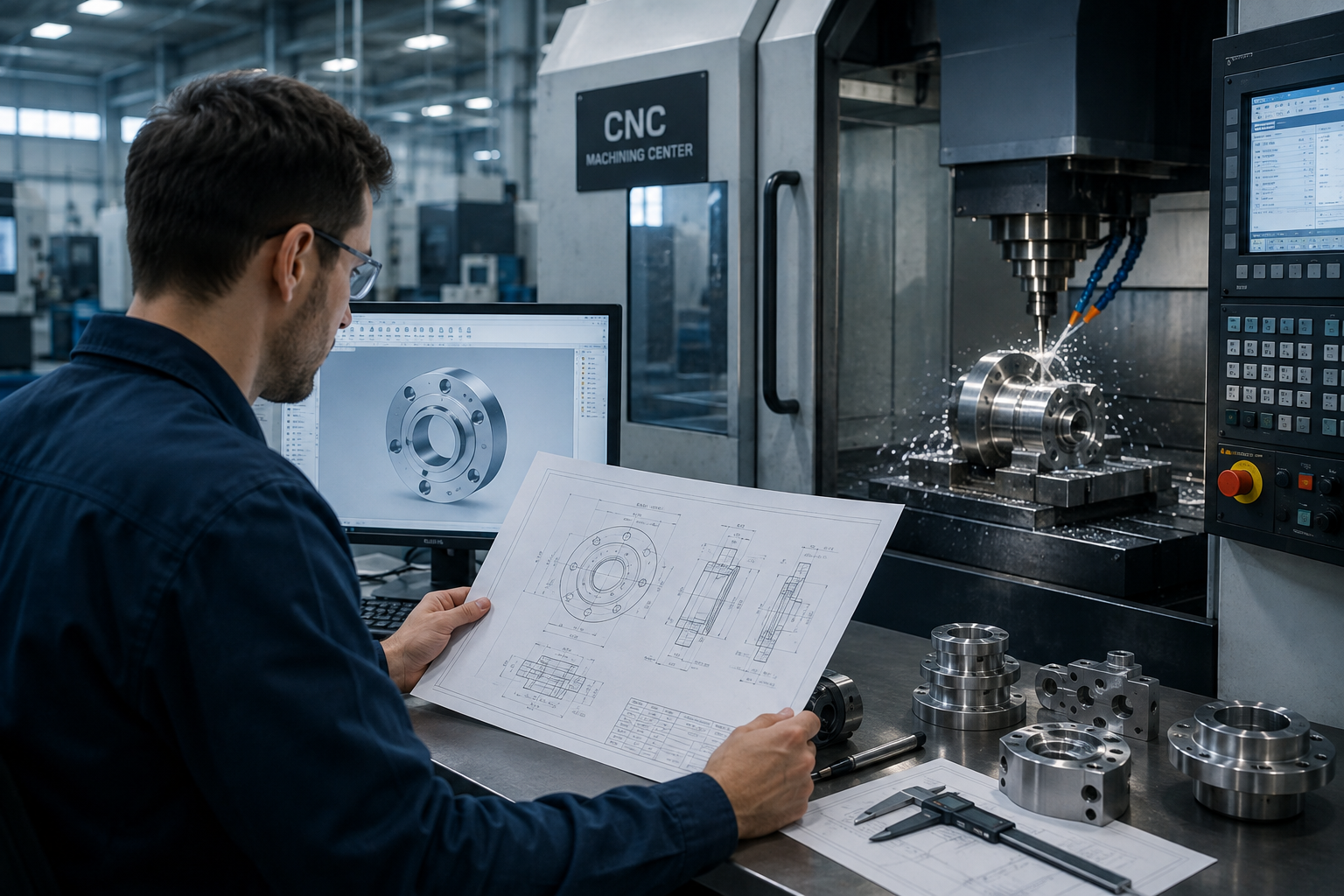
Designing a part for CNC machining requires more than creating a functional shape. The way a component is designed can have a significant impact on machining time, production cost, tolerances, and overall manufacturability.
A design that looks simple on a CAD model may require complex tooling, multiple setups, or additional machining operations in production.
By following CNC machining design guidelines from the beginning, engineers can reduce manufacturing costs, improve part quality, and shorten production lead times.
In this guide, we’ll cover 10 practical CNC machining design tips to help you create parts that are easier and more cost-effective to manufacture.
What Is Design for CNC Machining?
Design for CNC machining means creating a part with the manufacturing process in mind.
Unlike additive manufacturing, CNC machining removes material from a solid block or piece of stock. The cutting tools need sufficient access to the areas being machined.
A good CNC design should consider:
- Tool accessibility
- Part geometry
- Material selection
- Tolerances
- Wall thickness
- Hole sizes
- Internal corners
- Surface finish
- Number of machining setups
Designing with these factors in mind can help prevent manufacturing problems later in the process.
10 CNC Machining Design Tips
1. Avoid Unnecessarily Tight Tolerances
One of the most important CNC design principles is to avoid specifying tighter tolerances than necessary.
For example, a general dimension may only require a tolerance of ±0.10 mm, while a critical mating feature may require ±0.02 mm.
Tighter tolerances can increase:
- Machining time
- Inspection requirements
- Tool wear
- Production costs
Only apply precision tolerances to features that are critical to the function of your part.
For more information, see our guide to [CNC machining tolerances].
2. Use Standard Hole Sizes
Standard drill sizes are generally easier and faster to manufacture than unusual hole dimensions.
Whenever possible, use standard hole diameters that correspond to commonly available drills and cutting tools.
This can help reduce:
- Tool changes
- Machining time
- Tooling costs
For precision holes, additional processes such as reaming or boring may be required.
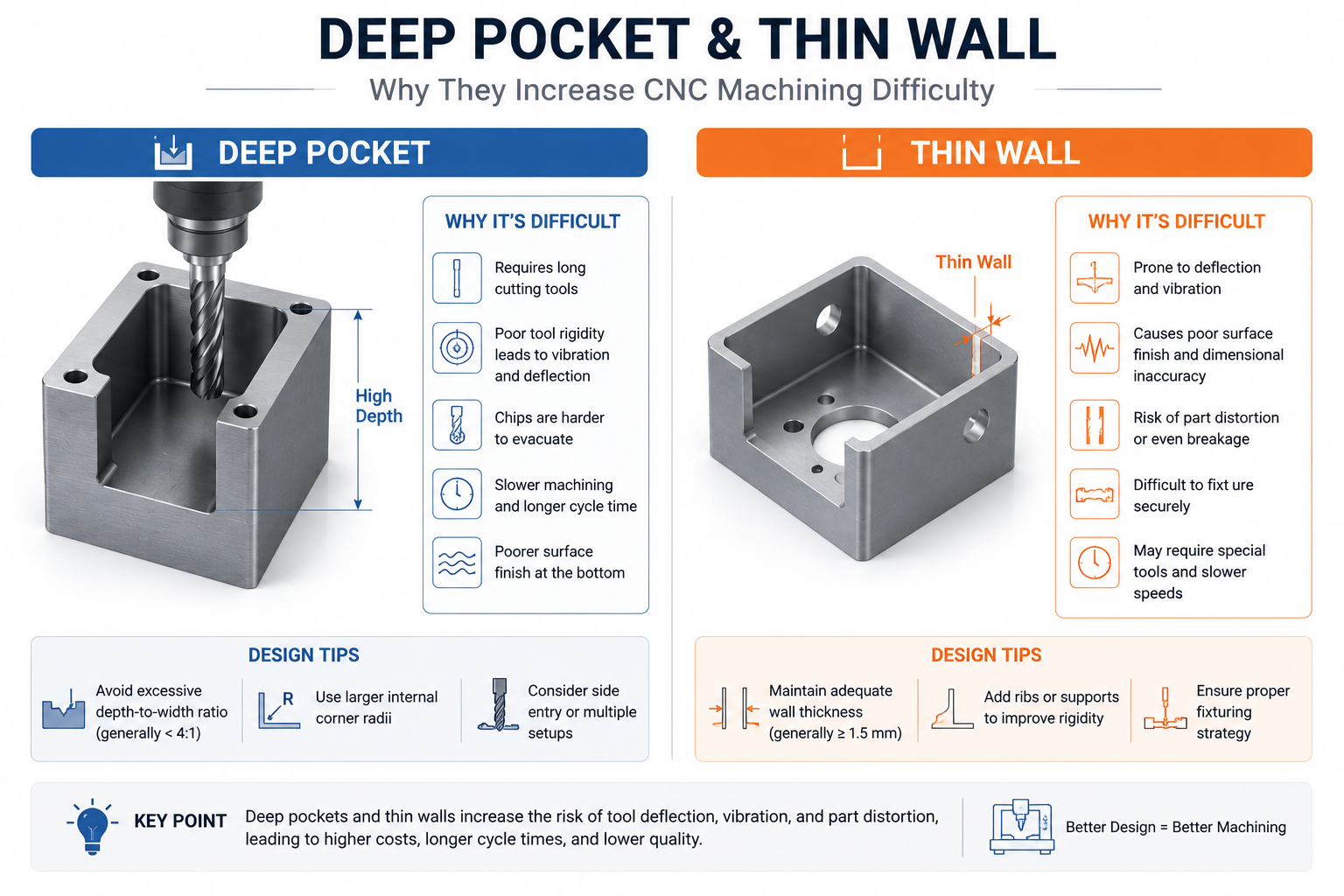
3. Avoid Deep and Narrow Pockets
Deep pockets can be challenging to machine because the cutting tool needs to reach deep into the part.
Long tools can also be more susceptible to:
- Vibration
- Tool deflection
- Reduced cutting performance
Whenever possible, keep pockets as shallow as practical and avoid extremely narrow features.
If a deep pocket is necessary, discuss the geometry with your machining partner before production.
4. Design Internal Corners With Appropriate Radii
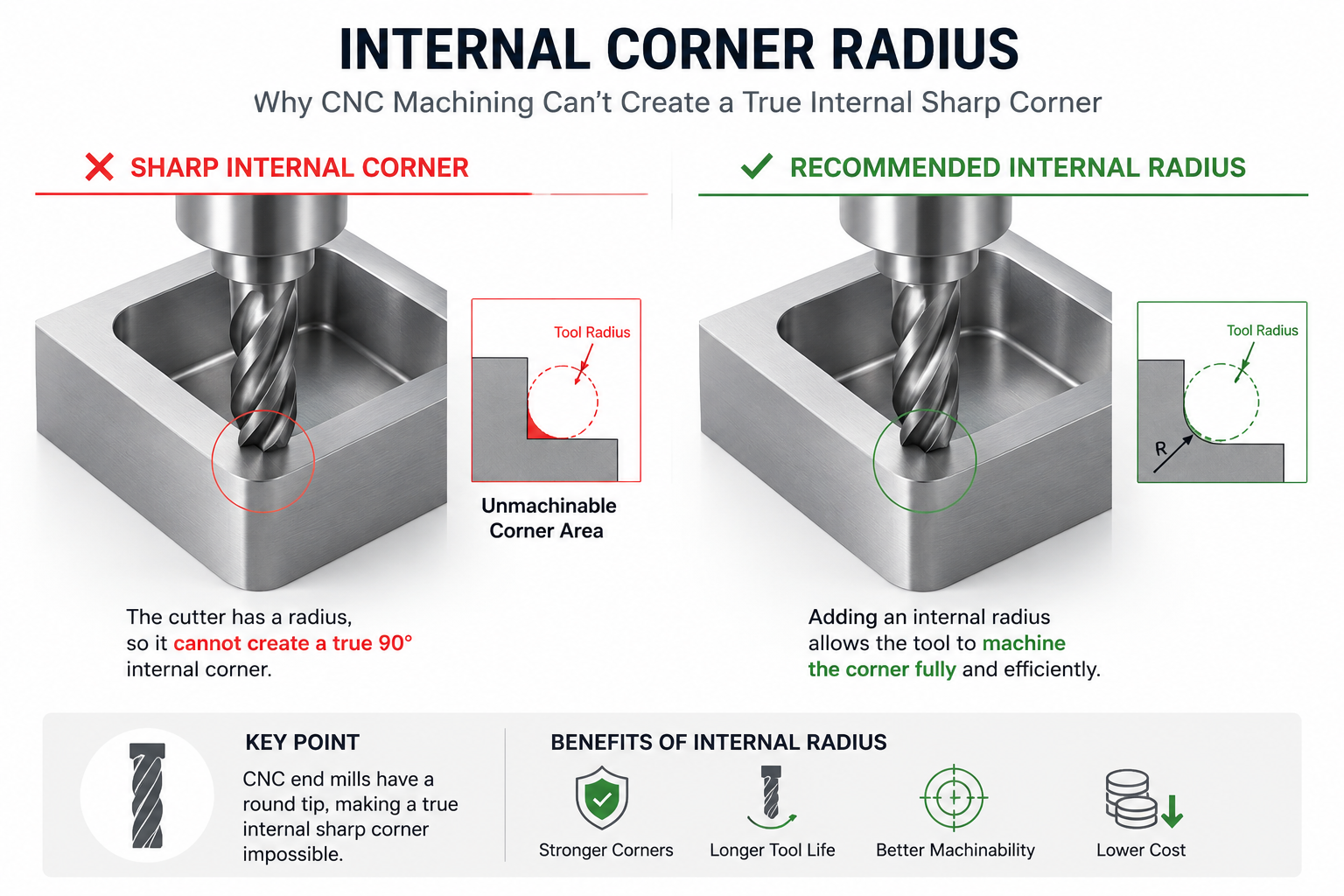
CNC milling cutters are generally round, which means they cannot create perfectly sharp internal corners.
For example, a standard end mill will naturally produce a radius at an internal corner.
Instead of designing a completely sharp internal corner, consider adding an appropriate radius.
Benefits include:
- Easier machining
- Reduced tool wear
- Faster production
- Lower manufacturing costs
Larger internal radii can often be machined more efficiently than very small radii.
5. Maintain Adequate Wall Thickness
Very thin walls can be difficult to machine accurately.
During cutting, thin sections may experience vibration or deformation.
As a general design principle, avoid unnecessarily thin walls and consider the material’s mechanical properties when determining wall thickness.
The ideal thickness depends on:
- Material
- Part geometry
- Wall height
- Machining method
- Required tolerances
If thin walls are essential to the design, your manufacturer can recommend an appropriate machining strategy.
6. Minimize the Number of Setups
Every time a part needs to be repositioned in the machine, additional setup and alignment work may be required.
Parts that can be machined efficiently in one or two setups are generally more economical than parts requiring many different orientations.
Try to design parts so that important features can be accessed from as few directions as possible.
Reducing the number of setups can improve:
- Production efficiency
- Dimensional consistency
- Machining cost
7. Choose Materials With Machinability in Mind
Material selection affects both performance and manufacturing cost.
Aluminum, for example, is generally easy to machine and is widely used for prototypes and production components.
Stainless steel offers excellent strength and corrosion resistance but can require more machining time.
Titanium provides excellent performance but is more difficult and expensive to machine.
When selecting a material, consider both the functional requirements and its machinability.
8. Avoid Unnecessary Surface Finishing
Surface finishing can improve appearance, corrosion resistance, and wear resistance, but every additional finishing process adds cost and production time.
Common CNC surface finishes include:
- Anodizing
- Bead blasting
- Polishing
- Powder coating
- Brushing
Only specify a particular surface finish where it provides a functional or aesthetic benefit.
For example, an internal component that is not visible may not require the same cosmetic finish as an external housing.
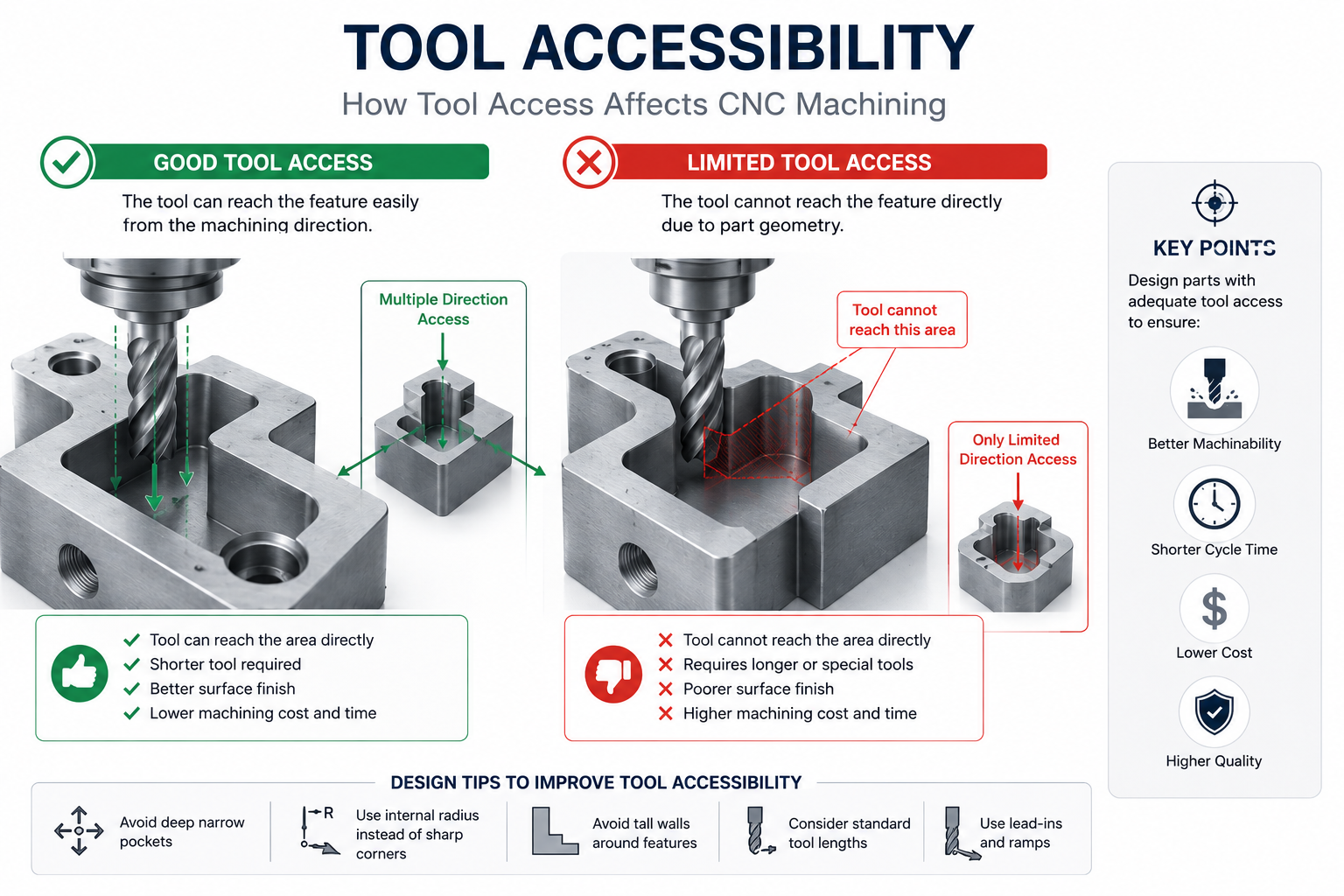
9. Design Features That Allow Easy Tool Access
CNC cutting tools need a clear path to reach the areas being machined.
Features that are difficult to access may require:
- Special tooling
- Multiple setups
- Longer tools
- Multi-axis machining
When designing a part, consider the direction from which the cutting tool will approach each feature.
Simple tool access generally means simpler and more cost-effective manufacturing.
10. Consider Manufacturing Requirements Early
One of the best ways to reduce CNC machining problems is to involve your manufacturing partner early in the design process.
Before production, engineers can review:
- CAD geometry
- Material
- Tolerances
- Surface finish
- Machining strategy
- Production quantity
This process is often referred to as Design for Manufacturability (DFM).
Early DFM feedback can identify potential manufacturing problems before they result in expensive redesigns.
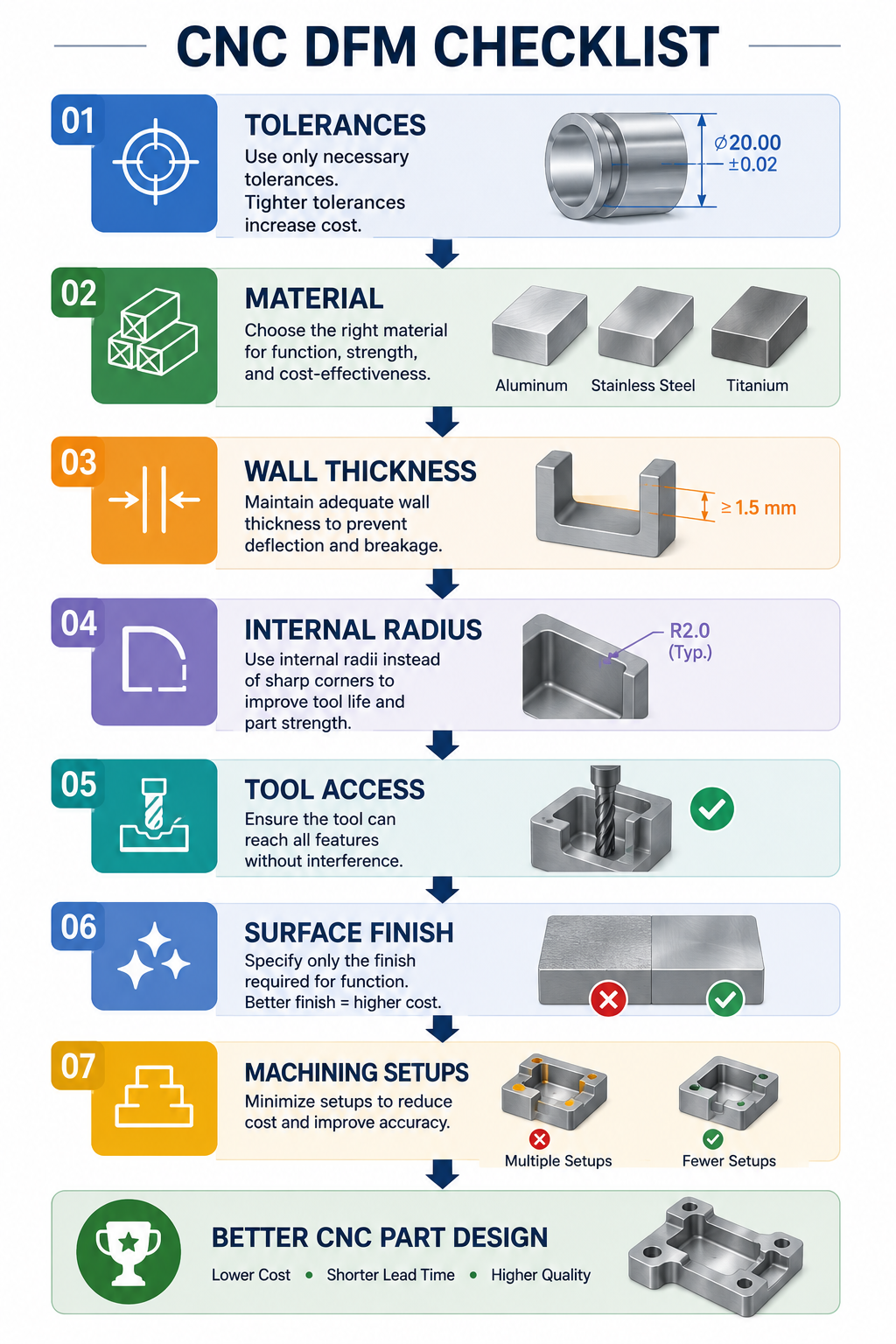
CNC Machining Design Checklist
Before sending your CAD file for manufacturing, review the following:
| Design Factor | Recommended Approach |
|---|---|
| Tolerances | Use tight tolerances only where necessary |
| Hole Sizes | Prefer standard sizes |
| Internal Corners | Use appropriate radii |
| Pocket Depth | Avoid unnecessarily deep pockets |
| Wall Thickness | Maintain sufficient thickness |
| Tool Access | Ensure cutting tools can reach features |
| Material | Balance performance and machinability |
| Surface Finish | Specify only when necessary |
| Setups | Minimize machining orientations |
| Geometry | Avoid unnecessary complexity |
How CNC Design Affects Manufacturing Cost
Good part design can significantly reduce CNC machining costs.
For example, a design with:
- Standard hole sizes
- Larger internal radii
- Moderate tolerances
- Simple tool access
- Fewer setups
is generally easier to manufacture than a highly complex design with extremely tight tolerances and difficult-to-reach features.
Design optimization doesn’t necessarily mean simplifying the function of a part. Instead, it means achieving the required performance using a geometry that is practical to manufacture.
CNC Machining Design for Different Materials
Different materials may require different design considerations.
Aluminum
Aluminum is highly machinable and is suitable for complex geometries, prototypes, and lightweight components.
Stainless Steel
Stainless steel provides excellent strength and corrosion resistance, but designers should consider its higher machining difficulty.
Titanium
Titanium offers an excellent strength-to-weight ratio but requires careful consideration of tooling, cutting conditions, and heat management.
Engineering Plastics
Materials such as POM, Nylon, and ABS can be machined efficiently, but designers should consider deformation, thermal expansion, and material properties.
Why DFM Matters for CNC Machining
Design for Manufacturability helps engineers identify potential production problems before manufacturing begins.
A DFM review can answer questions such as:
- Can the cutting tool reach every feature?
- Are the tolerances realistic?
- Are the walls thick enough?
- Can standard tools be used?
- Does the part require multiple setups?
- Is the selected material appropriate?
- Are the finishing requirements necessary?
Addressing these questions early can save both time and money.
CNC Machining Services at KG Precise
At KG Precise, we support customers from initial design review through CNC machining and finishing.
Our engineering team can review your CAD files and provide feedback on manufacturability, material selection, tolerances, surface finishing, and machining methods.
Whether you need a single prototype or low-volume production, our goal is to help you manufacture high-quality parts efficiently and cost-effectively.
Upload your CAD file to get started with your CNC machining project.
Conclusion
Good CNC machining starts with good design.
By considering tool accessibility, internal radii, wall thickness, tolerances, material selection, surface finishing, and machining setups during the design stage, you can reduce manufacturing costs and avoid unnecessary production problems.
The best CNC design is not simply the most precise or complex design. It is a design that achieves the required performance while remaining practical and efficient to manufacture.
If you’re unsure whether your design is suitable for CNC machining, working with an experienced manufacturing partner can help you identify potential issues before production begins.