 (+035) 527-1710-70
 NEWSLETTER


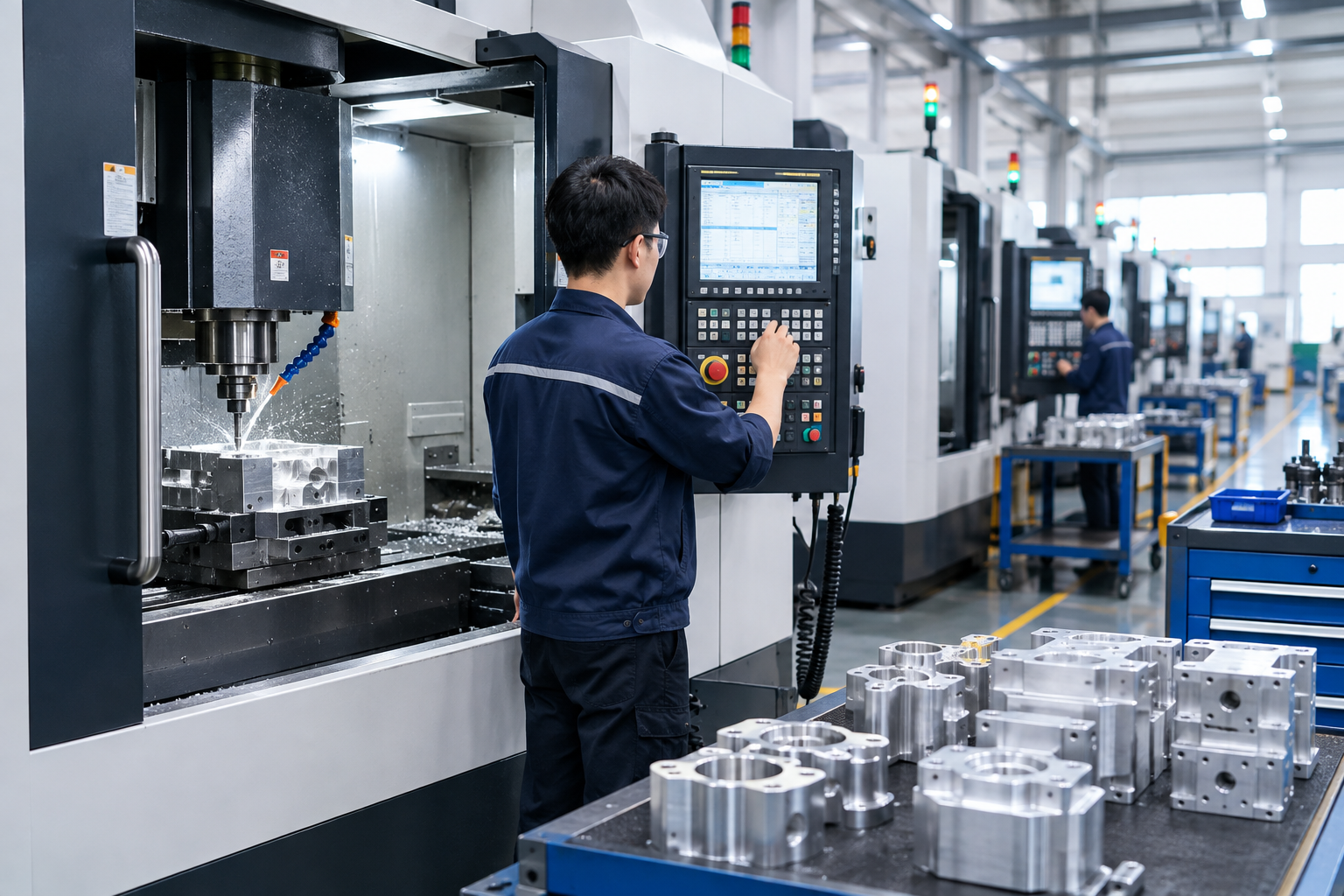
When ordering custom CNC machined parts, one of the first questions customers ask is: How long does CNC machining take?
The answer depends on several factors, including part complexity, material, quantity, machining processes, surface finishing, inspection requirements, and production capacity.
For simple CNC prototypes, production can sometimes be completed within a few days. More complex parts or larger production orders may require several weeks.
Understanding the CNC machining lead time can help you plan product development, prototypes, and production more efficiently.
In this guide, we will explain what CNC machining lead time means, how long different CNC projects typically take, and which factors can affect your delivery schedule.
What Is CNC Machining Lead Time?
CNC machining lead time is the total time required to complete a CNC manufacturing order, from receiving the design files and confirming the project requirements to machining, finishing, inspection, and final delivery.
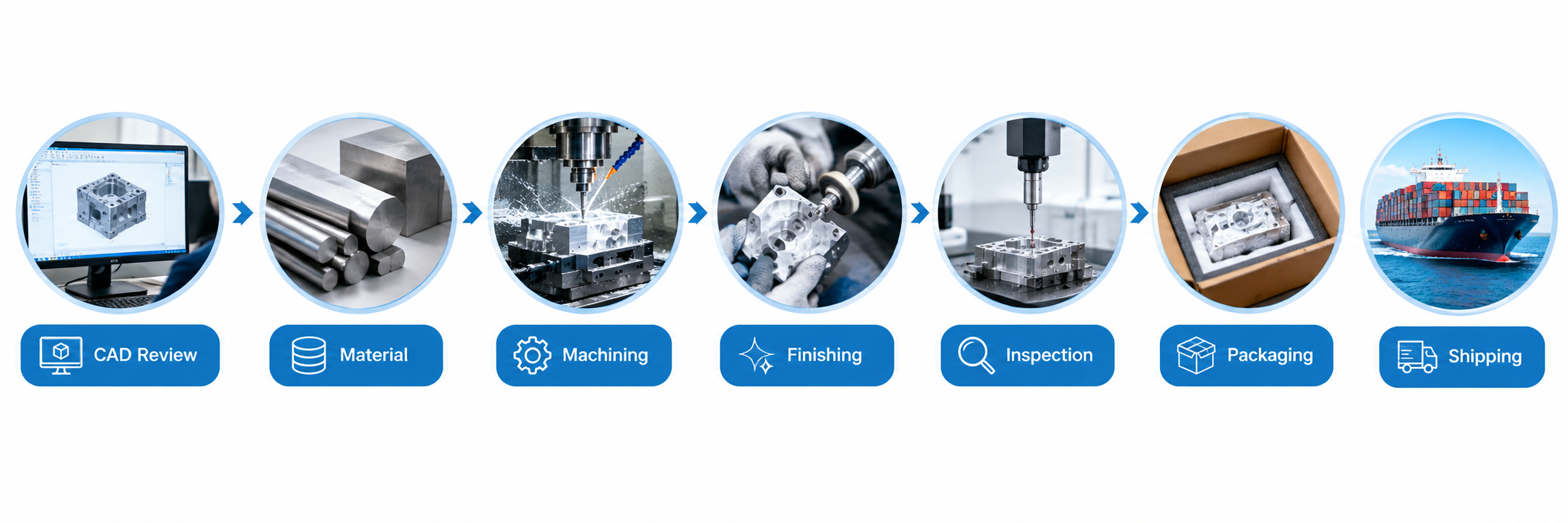
A typical CNC machining workflow includes:
- Design and CAD file review
- Engineering and DFM analysis
- Material preparation
- CNC machining
- Secondary processes
- Surface finishing
- Quality inspection
- Packaging and shipping
The actual machining time is only one part of the overall lead time.
For example, a part may require only a few hours of machine time but still take several days to complete because of material preparation, machine scheduling, surface finishing, or inspection.
How Long Does CNC Machining Take?
There is no single standard lead time for every CNC machining project.
As a general reference:
| CNC Project Type | Typical Lead Time |
|---|---|
| Simple CNC Prototype | 3–7 business days |
| Complex CNC Prototype | 5–10+ business days |
| Small Batch Production | 1–3 weeks |
| Medium Production Runs | 2–4+ weeks |
| Complex Multi-Axis Parts | 1–3+ weeks |
| Parts With Special Finishing | Add several days |
These are general estimates rather than fixed delivery times. The actual schedule depends on the part design, material, quantity, machining requirements, finishing, inspection, and shipping method.
For urgent projects, some manufacturers may also offer expedited CNC machining services.
What Factors Affect CNC Machining Lead Time?
Several factors can significantly change how long a CNC machining project takes.
1. Part Complexity
The geometry of a part has a major impact on production time.
Simple components with basic pockets, holes, and flat surfaces are generally faster to manufacture than complex parts with:
- Deep cavities
- Thin walls
- Complex curved surfaces
- Tight tolerances
- Difficult-to-machine features
- Multiple setups
Complex geometries may require additional programming, specialized tooling, multiple setups, or multi-axis machining.
As a result, a complex five-axis component can take considerably longer than a simple three-axis milled part.
2. Material Selection
Different materials require different machining strategies.
Aluminum is generally easy to machine and can often be processed relatively quickly. Stainless steel, titanium, tool steel, and other harder materials may require slower cutting speeds, specialized tooling, and additional machining time.
Material availability can also affect lead time.
If the required material is readily available, production can begin sooner. If the material needs to be specially ordered, additional waiting time may be required before machining starts.
3. Part Quantity
Quantity has a significant effect on production planning.
For a single prototype, the manufacturer only needs to prepare and machine a small number of parts.
For larger production orders, additional time may be needed for:
- Machine scheduling
- Material preparation
- Tooling
- Production setup
- Batch machining
- In-process inspection
- Final inspection
However, increasing quantity does not necessarily increase lead time proportionally.
Once a machine is set up and the CNC program has been verified, multiple identical parts can often be produced efficiently in the same production run.
4. CNC Machining Process
Different CNC processes require different amounts of production time.
Common processes include:
- CNC milling
- CNC turning
- CNC drilling
- CNC grinding
- CNC engraving
- Wire EDM
For example, a simple turned shaft may require only a few machining operations, while a complex milled housing may require multiple setups and tools.
Some parts also require several machining processes before they are complete.
5. Tolerance Requirements
Tighter tolerances generally require more time and attention.
A standard CNC part may be produced with relatively straightforward machining and inspection.
Parts requiring very tight dimensional tolerances may need:
- Additional machining passes
- More careful setup
- Temperature control
- Specialized measuring equipment
- Additional inspection
- CMM measurement
Therefore, specifying unnecessarily tight tolerances can increase both manufacturing time and cost.
For more information, see our guide to CNC machining tolerances.
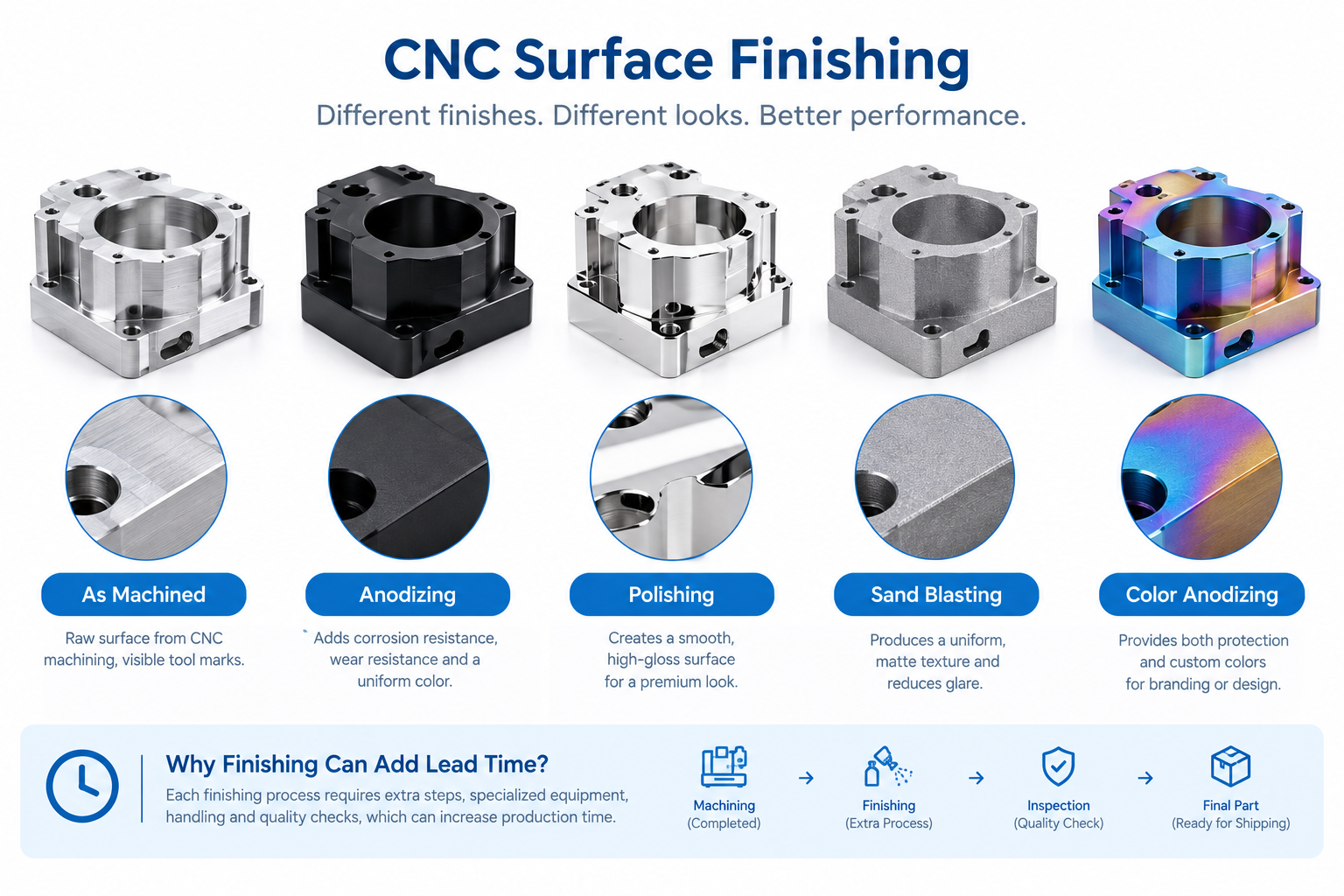
6. Surface Finishing
CNC machining does not always produce the final appearance or surface condition required by the customer.
Depending on the application, a machined part may require additional finishing processes such as:
- Anodizing
- Powder coating
- Electroless nickel plating
- Polishing
- Brushing
- Sandblasting
- Bead blasting
- Passivation
Some finishes can be completed relatively quickly, while others require additional processing time because the parts need to be sent to a specialized finishing supplier.
7. Quality Inspection Requirements
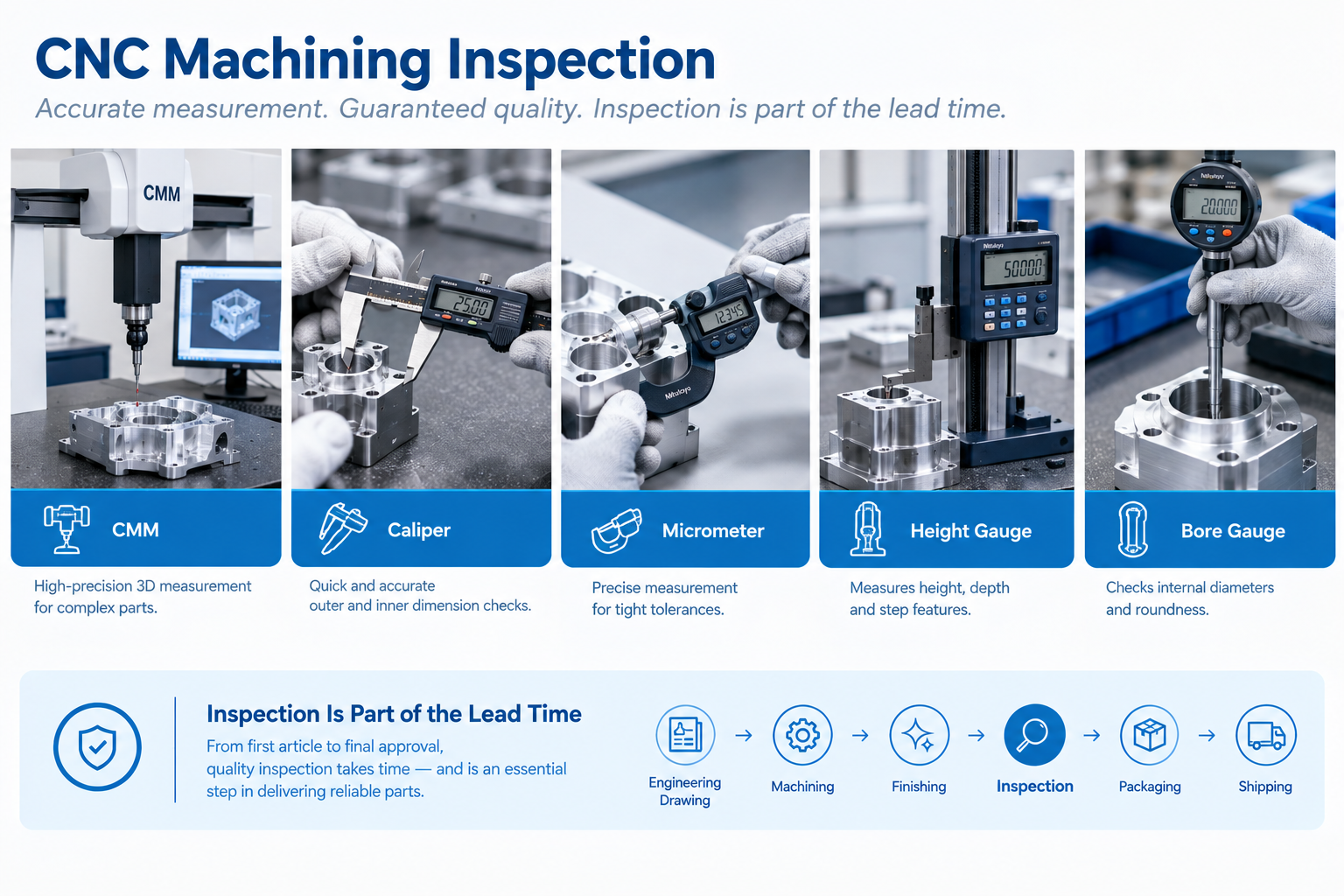
Inspection is another important part of the production schedule.
Simple parts may only require standard dimensional inspection using tools such as calipers and micrometers.
More demanding projects may require:
- First Article Inspection (FAI)
- CMM inspection
- GD&T verification
- Surface roughness measurement
- Material certification
- Detailed inspection reports
When a project has extensive inspection requirements, additional time should be included in the production schedule.
8. Material and Component Availability
Lead time can be affected by the availability of raw materials and additional components.
For example, a manufacturer may need to wait for:
- Special aluminum or steel grades
- Engineering plastics
- Custom fasteners
- Inserts
- Bearings
- Special coatings
Choosing commonly available materials and standard components can help shorten the overall production schedule.
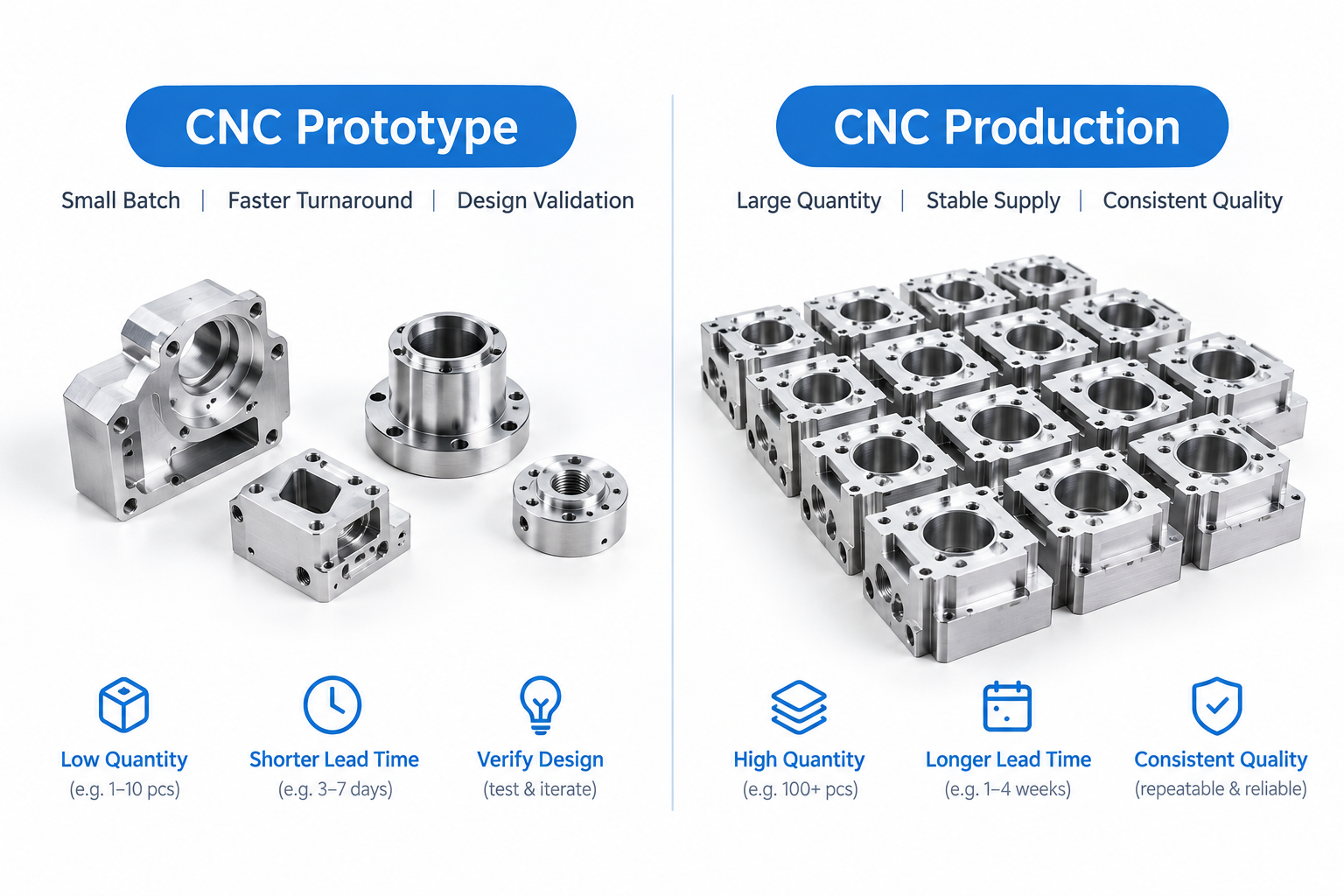
CNC Prototype Lead Time vs. Production Lead Time
Prototype machining and production machining have different scheduling requirements.
CNC Prototype
Prototype parts are usually produced in smaller quantities and are intended for testing, design validation, or functional evaluation.
A typical prototype project may take several business days depending on complexity.
Because prototype orders are usually small, manufacturers can often prioritize them for rapid production.
CNC Production
Production orders typically involve larger quantities and more extensive production planning.
Before production begins, manufacturers may need to confirm:
- Production quantity
- Material availability
- CNC programs
- Tooling
- Machine capacity
- Inspection requirements
- Surface finishing
- Packaging
As a result, production orders may require more time than simple prototypes.
How to Reduce CNC Machining Lead Time
If your project has a tight deadline, there are several ways to help reduce manufacturing time.
1. Submit Complete CAD Files
Providing complete and accurate design files allows the manufacturer to begin engineering review more quickly.
Common file formats include:
- STEP
- STP
- IGES
- STL
- PDF drawings
For parts with critical dimensions or tolerances, 2D engineering drawings can provide additional manufacturing information.
2. Use Standard Materials When Possible
Selecting readily available materials can help avoid delays caused by material procurement.
For example, commonly used grades such as aluminum 6061 and aluminum 7075 are often easier to source than highly specialized materials.
3. Avoid Unnecessary Tight Tolerances
Only specify tight tolerances where they are functionally necessary.
Overly restrictive tolerances can require additional machining and inspection, increasing both production time and cost.
A well-designed tolerance scheme helps manufacturers produce parts efficiently without compromising function.
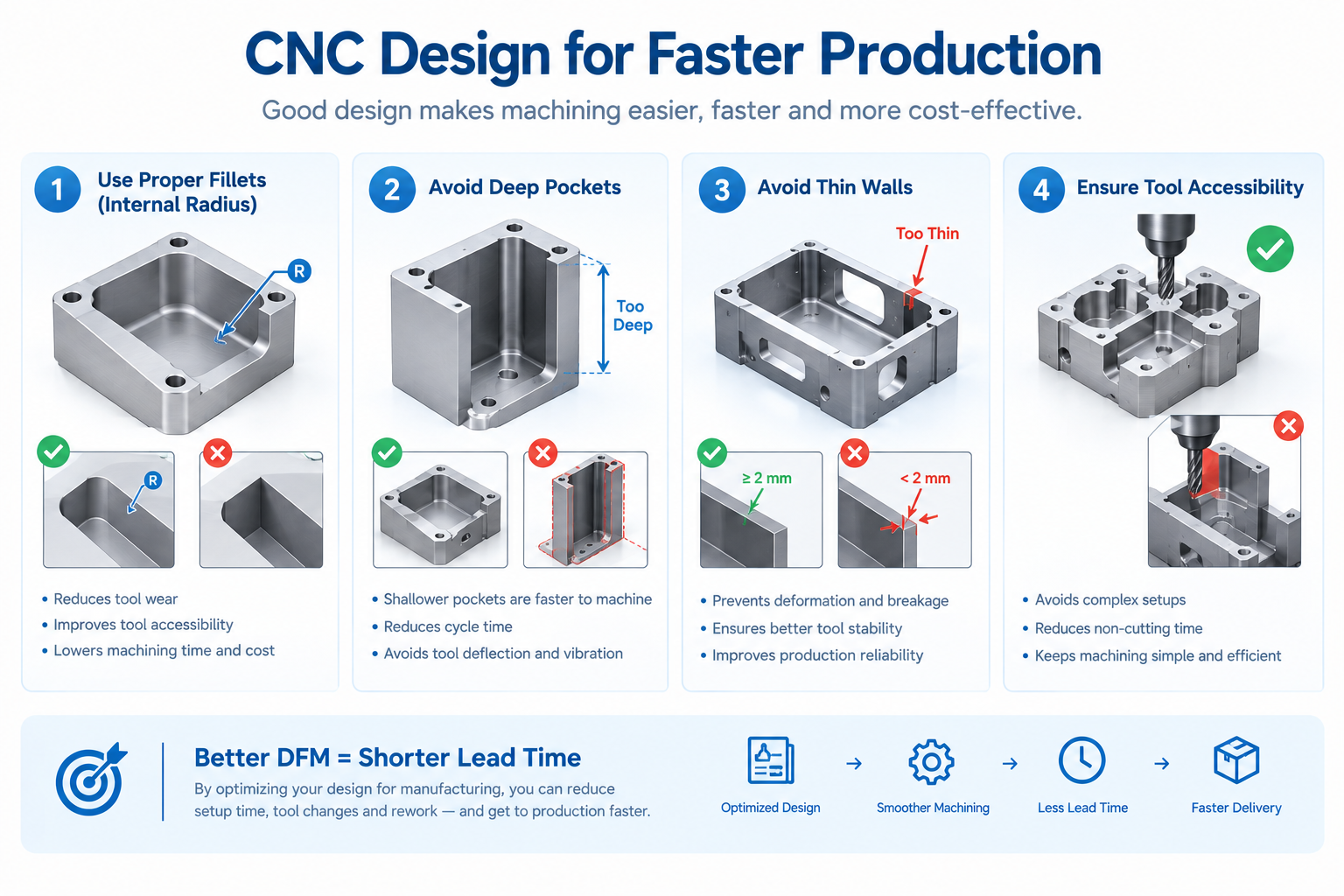
4. Simplify the Part Design
Design for manufacturability can significantly improve production efficiency.
Consider:
- Avoiding unnecessarily deep pockets
- Providing appropriate internal corner radii
- Avoiding extremely thin walls
- Making features accessible to standard cutting tools
- Reducing unnecessary setups
A design that is easier to machine is generally faster to produce.
5. Minimize Unnecessary Finishing Requirements
If a particular surface finish is not necessary for the function or appearance of the part, consider whether it can be simplified.
Every additional process can add time to the manufacturing schedule.
6. Communicate the Deadline Clearly
If your project has a specific delivery deadline, tell the manufacturer before production begins.
This allows the supplier to evaluate whether the requested schedule is realistic and determine whether expedited production or shipping is necessary.
Can CNC Machining Be Completed in 24 Hours?
In some cases, yes.
Simple CNC parts with readily available materials, straightforward geometry, and standard finishing may qualify for rapid production.
However, 24-hour CNC machining is not realistic for every project.
Complex parts may require additional programming, multiple setups, special materials, surface finishing, or detailed inspection.
When requesting an urgent CNC order, provide the following information as early as possible:
- CAD files
- 2D drawings
- Material
- Quantity
- Tolerances
- Surface finish
- Inspection requirements
- Required delivery date
The more complete the information, the faster the manufacturer can evaluate the project.
CNC Machining Lead Time vs. Shipping Time
It is important to distinguish between manufacturing lead time and total delivery time.
Manufacturing lead time covers the production process, while total delivery time also includes shipping.
For example:
Engineering review → Material preparation → CNC machining → Surface finishing → Inspection → Packaging → Shipping → Delivery
Even if machining is completed quickly, international shipping can add additional time.
When planning a project, always consider the complete timeline rather than only the machining time.
How to Get a Faster CNC Machining Quote
A fast quotation process can help reduce the overall project timeline.
To receive a quote more efficiently, provide:
- 3D CAD files
- 2D drawings when necessary
- Material requirements
- Part quantity
- Surface finish requirements
- Required tolerances
- Inspection requirements
- Target delivery date
With complete project information, the manufacturer can review manufacturability, calculate production requirements, and provide a more accurate quotation.
CNC Machining Lead Time at KG Precise
At KG Precise, we provide CNC machining and precision manufacturing services for prototypes, small-batch production, and larger production requirements.
Our CNC manufacturing capabilities include:
- CNC milling
- CNC turning
- CNC drilling
- CNC grinding
- CNC engraving
- Wire EDM
We also provide a range of secondary processes and surface finishing options to help customers complete their parts through a streamlined manufacturing process.
For urgent projects, our team can review your CAD files and production requirements to determine the most suitable manufacturing schedule.
The actual lead time depends on the specific part design, material, quantity, finishing, inspection requirements, and shipping method.
Providing complete project information at the quotation stage is the best way to establish an accurate delivery schedule.
Frequently Asked Questions About CNC Machining Lead Time
How many days does CNC machining take?
Simple CNC prototypes can sometimes be completed within 3–7 business days. More complex parts, larger quantities, special materials, and additional finishing or inspection may require longer.
What is the fastest CNC machining lead time?
Some simple CNC parts may qualify for expedited production and can potentially be completed within 24 hours. However, this depends on part complexity, material availability, quantity, finishing, inspection, and machine capacity.
Does CNC machining take longer for large quantities?
Large production orders generally require more planning and machining time, but the lead time does not necessarily increase proportionally with quantity because multiple identical parts can be produced efficiently in the same production run.
Does surface finishing increase CNC machining lead time?
Yes. Processes such as anodizing, powder coating, plating, polishing, and specialized finishing can add additional production time.
How can I make my CNC project faster?
Provide complete CAD files and drawings, use readily available materials, avoid unnecessary tight tolerances, simplify the design where possible, and communicate your required delivery date early.
Conclusion
CNC machining lead time depends on much more than the amount of time a part spends inside a CNC machine.
Part complexity, material, quantity, machining process, tolerances, surface finishing, inspection, and shipping can all affect the final delivery schedule.
For the fastest possible production, provide complete design information, choose practical materials and tolerances, and work with a manufacturer that can manage machining, finishing, and inspection efficiently.
Whether you need a single prototype or a larger production run, understanding these factors can help you plan your CNC manufacturing project more accurately and avoid unexpected delays.