 (+035) 527-1710-70
 NEWSLETTER


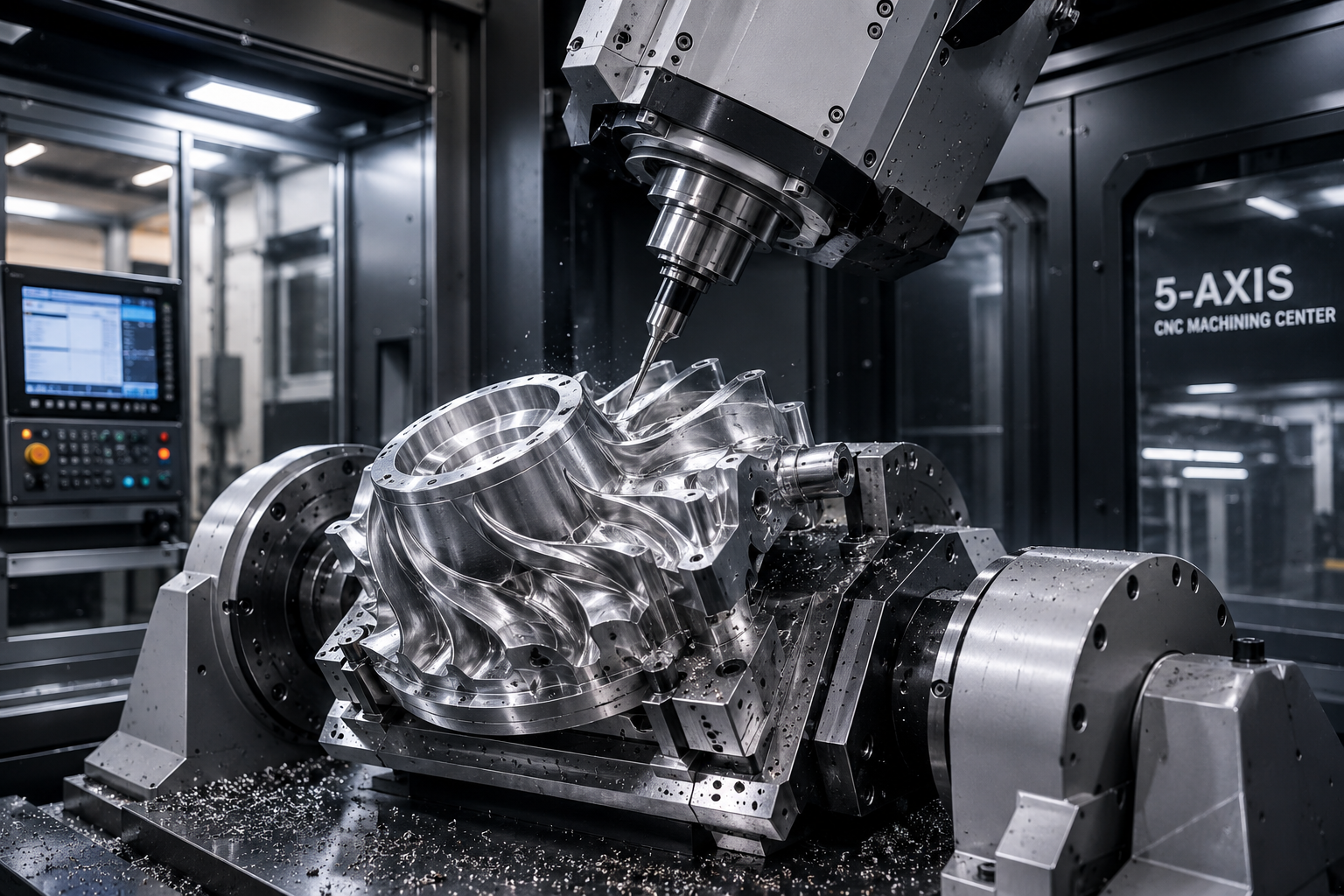
Modern manufacturing requires increasingly complex parts with higher precision and shorter production times. For components with complex geometries, multiple surfaces, or difficult-to-reach features, traditional 3-axis CNC machining may not always be the most efficient solution.
This is where 5-axis CNC machining comes in.
By allowing the cutting tool and workpiece to move along five axes, 5-axis machining can produce complex components with fewer setups while maintaining high dimensional accuracy.
In this guide, we’ll explain what 5-axis CNC machining is, how it works, its advantages, applications, limitations, and when you should consider using it for your project.
What Is 5-Axis CNC Machining?
5-axis CNC machining is a manufacturing process that allows a cutting tool to move relative to a workpiece along five different axes simultaneously or sequentially.
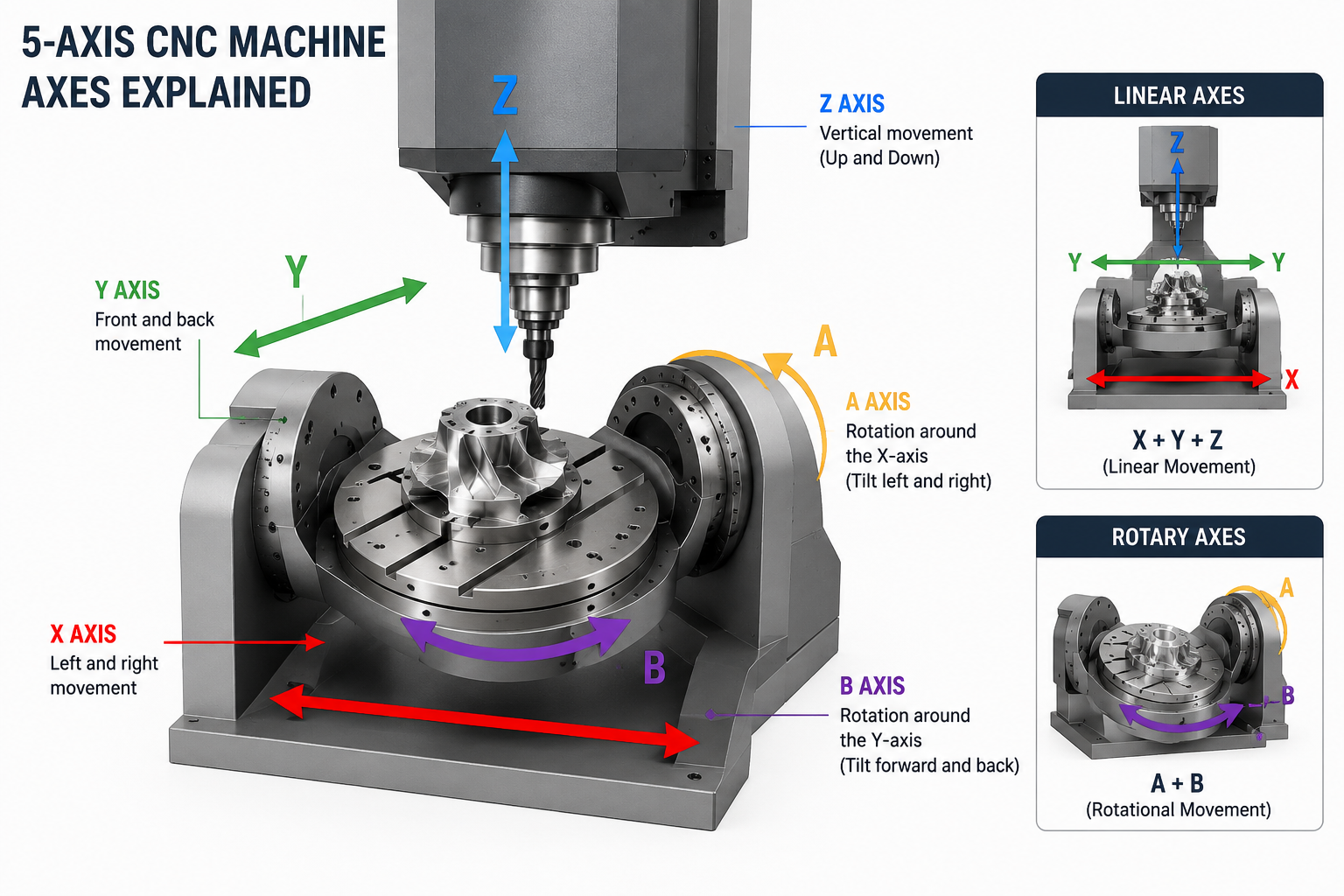
A traditional 3-axis CNC machine typically moves along:
- X-axis
- Y-axis
- Z-axis
A 5-axis CNC machine adds two rotational axes.
The additional rotational movement allows the cutting tool to approach the workpiece from different angles.
This makes it possible to machine multiple surfaces and complex geometries without repeatedly repositioning the part.
How Does 5-Axis CNC Machining Work?
The basic machining process is similar to other CNC machining methods, but 5-axis machines provide additional movement and flexibility.
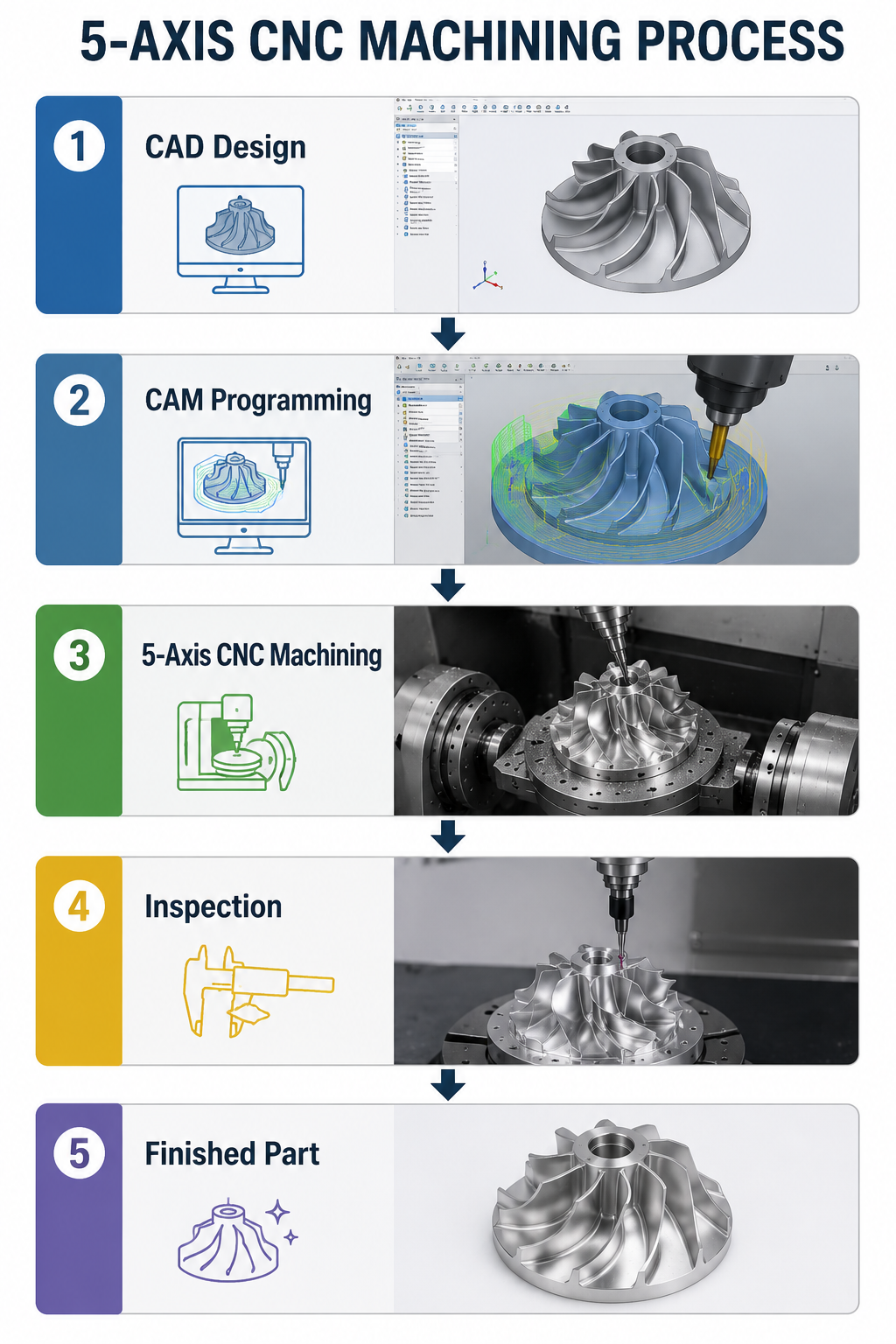
1. Create a CAD Model
The process starts with a 3D CAD model containing the geometry and dimensions of the desired component.
Common CAD file formats include:
- STEP
- IGES
- STL
- DWG
The CAD model is then prepared for manufacturing.
2. Generate CNC Toolpaths
CAM software converts the CAD model into machine instructions.
For 5-axis machining, the CAM system must calculate:
- Tool movement
- Cutting angles
- Tool orientation
- Feed rates
- Collision avoidance
Because the machine can move in multiple directions, programming a 5-axis part can be more complex than programming a standard 3-axis component.
3. Secure the Workpiece
The raw material is securely mounted in the machine.
One of the main benefits of 5-axis machining is that the part may require fewer setups than a comparable 3-axis process.
4. Machine the Part
The cutting tool approaches the workpiece from different angles while material is removed.
This allows the machine to reach surfaces and features that would otherwise require repositioning.
5. Inspect the Finished Part
After machining, the component can be inspected using precision measurement equipment.
Depending on the project, inspection may include:
- Dimensional measurement
- Surface inspection
- CMM inspection
- Tolerance verification
The Five Axes Explained
Understanding the five axes helps explain why 5-axis machining is so versatile.
X Axis
Moves the cutting tool or workpiece horizontally from left to right.
Y Axis
Moves the cutting tool or workpiece forward and backward.
Z Axis
Moves the cutting tool vertically.
A Axis
Rotates around the X-axis.
B Axis
Rotates around the Y-axis.
The exact configuration can vary depending on the machine design.
Some machines rotate the cutting head, while others rotate the workpiece.
5-Axis vs 3-Axis CNC Machining
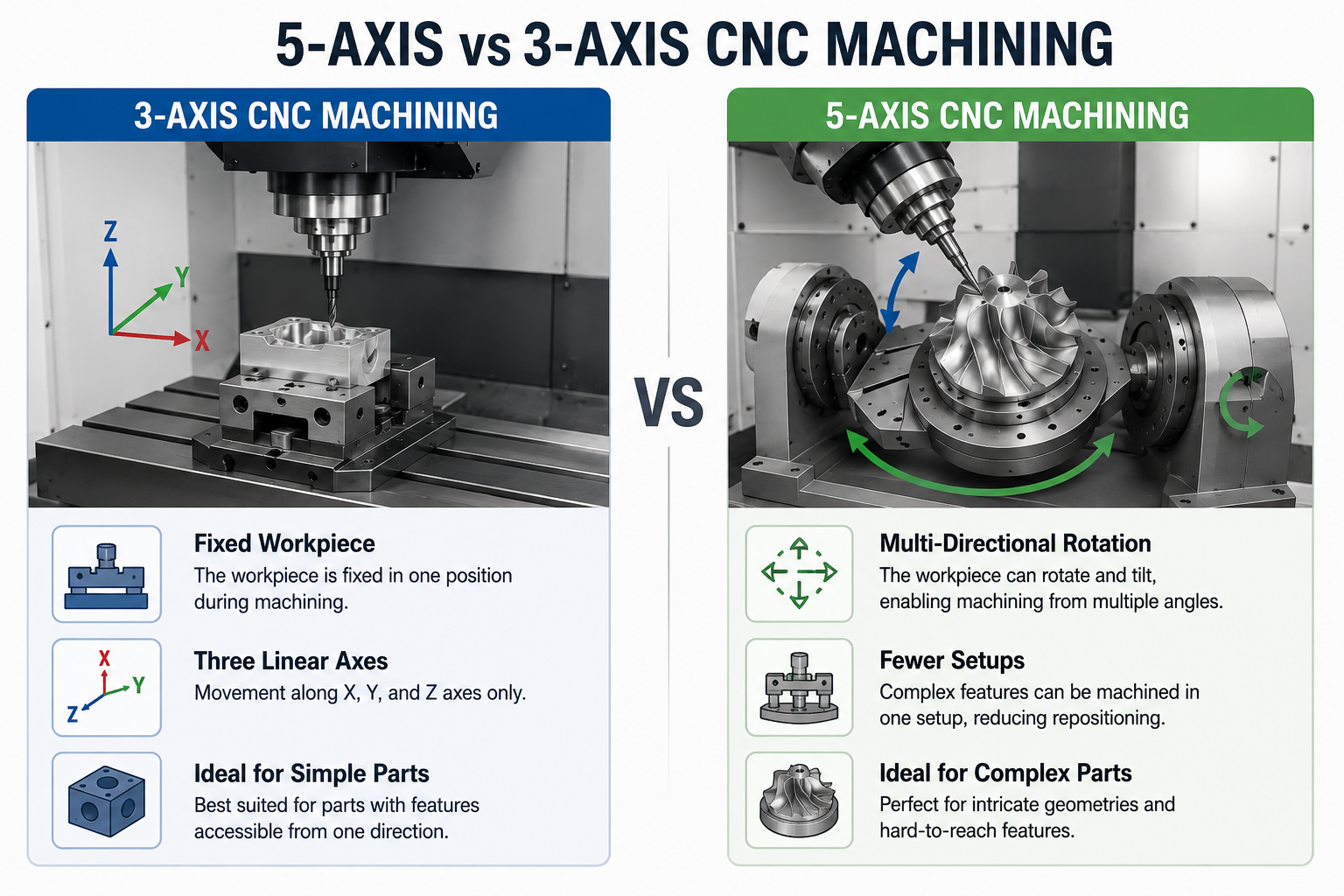
Both 3-axis and 5-axis machining are useful, but they are suited to different applications.
| Feature | 3-Axis CNC | 5-Axis CNC |
|---|---|---|
| Linear Axes | 3 | 3 |
| Rotary Axes | None | 2 |
| Part Complexity | Simple to Moderate | Complex |
| Setups | More for complex parts | Often fewer |
| Tool Access | Limited | Excellent |
| Programming | Simpler | More complex |
| Machining Cost | Lower | Higher |
| Best For | Simple parts | Complex geometries |
A 5-axis machine is not automatically better for every project.
For simple components, 3-axis machining may provide a more cost-effective solution.
Benefits of 5-Axis CNC Machining
1. Complex Geometries
One of the biggest advantages of 5-axis machining is its ability to manufacture complex shapes.
It is particularly useful for:
- Curved surfaces
- Angled features
- Deep cavities
- Complex contours
- Multi-sided components
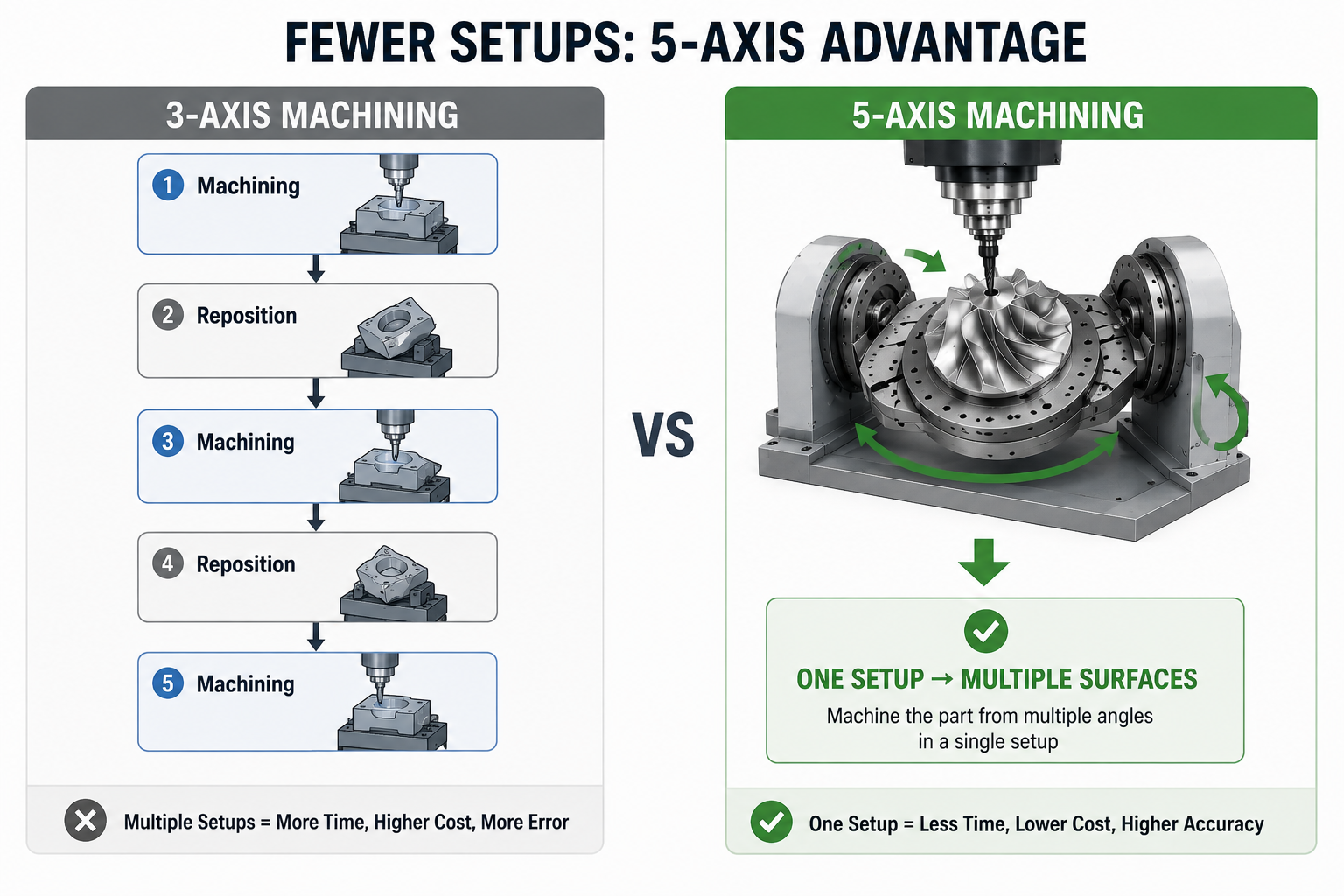
2. Fewer Setups
Traditional machining may require the operator to reposition a part multiple times.
Each additional setup can introduce:
- Alignment errors
- Additional labor
- Longer production times
5-axis machining can often access multiple surfaces in a single setup.
This can improve both efficiency and dimensional consistency.
3. Improved Surface Finish
5-axis machining allows the cutting tool to maintain a more favorable orientation relative to the workpiece.
This can reduce unnecessary tool movement and help produce smoother surfaces.
It is particularly beneficial for components with complex curved surfaces.
4. Better Tool Accessibility
The additional rotational axes allow cutting tools to reach difficult areas more easily.
This is especially useful for:
- Deep pockets
- Angled surfaces
- Complex cavities
- Undercut-like features
Better tool access can reduce the need for special fixtures and multiple machining operations.
5. High Precision
Fewer setups can reduce the possibility of errors caused by repositioning the workpiece.
This can be particularly important for parts where several surfaces need to maintain precise relationships with each other.
Applications of 5-Axis CNC Machining
5-axis machining is widely used in industries that require complex, high-precision components.
Aerospace
Typical applications include:
- Aircraft structural components
- Engine components
- Turbine parts
- Complex brackets
Aerospace components often require complex geometries combined with lightweight designs.
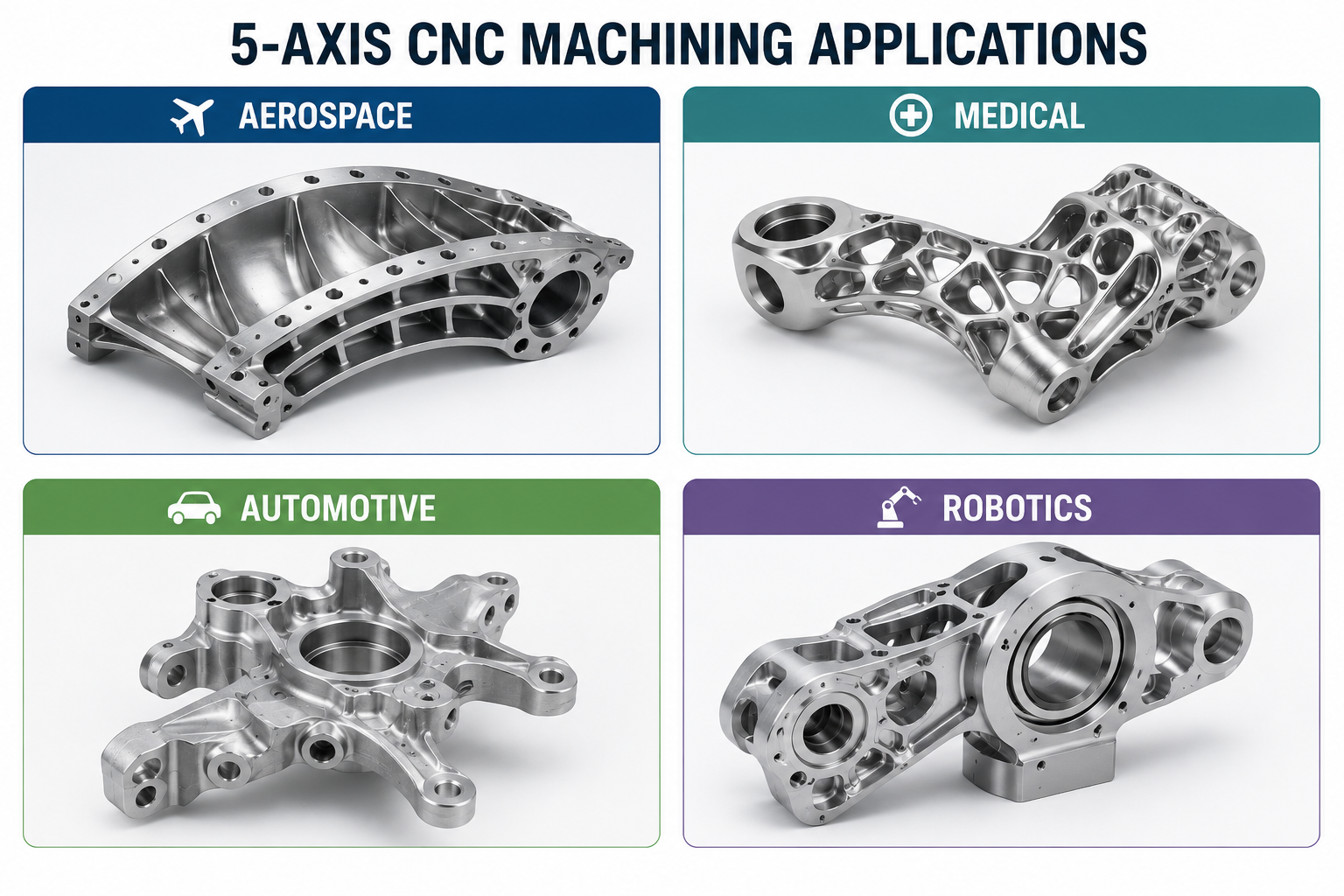
Medical
5-axis machining can be used to manufacture:
- Surgical components
- Medical equipment parts
- Prosthetic components
- Orthopedic components
High precision and complex geometries make 5-axis machining useful for demanding medical applications.
Automotive
Applications can include:
- Engine components
- Transmission parts
- Performance components
- Complex housings
Robotics
5-axis machining can produce:
- Robot joints
- End-effectors
- Structural components
- Custom mechanical parts
Industrial Equipment
Complex machine components and specialized tooling can also benefit from 5-axis machining.
When Should You Use 5-Axis CNC Machining?
5-axis machining is especially useful when a part has:
- Complex curved surfaces
- Multiple angled features
- Multiple machined faces
- Difficult-to-access areas
- Strict positional requirements
It can also be a good option when reducing the number of setups is important.
However, for simple parts, a 3-axis or CNC turning process may be more economical.
The best process depends on the geometry and manufacturing requirements of the part.
Is 5-Axis CNC Machining More Expensive?
Generally, 5-axis machining can have a higher hourly machining cost than 3-axis machining.
This is because 5-axis machines typically involve:
- More advanced equipment
- More complex programming
- Higher setup requirements
- More sophisticated tooling
However, the total cost of a finished part does not depend only on the machine’s hourly rate.
A 5-axis process can sometimes reduce total manufacturing costs by:
- Reducing setups
- Reducing fixture requirements
- Shortening machining time
- Improving tool access
- Combining multiple operations
Therefore, the most economical process should be evaluated based on the entire manufacturing process rather than machine rate alone.
5-Axis CNC Machining Design Tips
If you are designing a component for 5-axis machining, consider the following guidelines.
Keep Features Accessible
Although 5-axis machines offer excellent tool access, extremely difficult geometries can still increase programming and machining requirements.
Avoid Unnecessary Complexity
Do not add complex surfaces simply because the machine can produce them.
Use complex geometry only when it provides a functional benefit.
Specify Realistic Tolerances
Tight tolerances should only be applied to critical dimensions.
Unnecessary precision can increase machining and inspection costs.
Consider Tool Clearance
Make sure the cutting tool has sufficient clearance around the workpiece.
Discuss the Design Early
A DFM review before production can identify potential problems and help determine whether 5-axis machining is actually necessary.
5-Axis Machining vs. 3D Printing
For highly complex components, engineers may also consider 3D printing.
The two processes have different advantages.
| Feature | 5-Axis CNC Machining | 3D Printing |
| Process | Material removal | Additive manufacturing |
| Metals | Excellent | Depends on technology |
| Surface Finish | Excellent | Process dependent |
| Dimensional Accuracy | High | Technology dependent |
| Complex Internal Structures | Limited | Excellent |
| Functional Metal Parts | Excellent | Depends on process |
| Material Selection | Wide | Technology dependent |
5-axis machining is often preferred when the component requires excellent surface quality, dimensional accuracy, and conventional engineering materials.
3D printing may be better for extremely complex internal geometries that are difficult or impossible to machine.
How to Reduce 5-Axis Machining Costs
Although 5-axis machining can be more expensive than simpler CNC processes, several design decisions can help control costs.
1. Reduce Unnecessary Features
Simpler geometry generally requires less programming and machining time.
2. Use Standard Materials
Common materials are usually easier to source and machine.
3. Apply Appropriate Tolerances
Avoid specifying extremely tight tolerances across the entire part.
4. Optimize the Number of Operations
A good machining strategy can take advantage of the machine’s multi-axis capabilities.
5. Work With Your Manufacturer Early
Early engineering feedback can help determine whether 5-axis machining is necessary or whether a simpler process can achieve the same result.
5-Axis CNC Machining Services at KG Precise
At KG Precise, we provide precision CNC machining solutions for complex prototypes and low-volume production parts.
Our CNC machining capabilities can support complex geometries, multi-sided components, and precision mechanical parts.
Our engineering team can review your CAD files and recommend an appropriate machining strategy based on:
- Part geometry
- Material
- Tolerances
- Surface finish
- Production volume
- Budget
Whether your project requires standard CNC milling or advanced multi-axis machining, we can help you select an efficient manufacturing solution.
Upload your CAD file to request a quote.
Conclusion
5-axis CNC machining provides manufacturers with greater flexibility when producing complex and high-precision components.
By adding two rotational axes to traditional X, Y, and Z movements, 5-axis machines can access multiple surfaces, reduce setups, improve tool accessibility, and produce complex geometries more efficiently.
However, 5-axis machining is not always the most economical option. For simpler components, 3-axis CNC milling or CNC turning may provide a more cost-effective solution.
The right machining process ultimately depends on your part’s geometry, material, tolerances, surface finish, quantity, and production requirements.
If you’re unsure which CNC machining process is right for your project, an experienced manufacturing partner can help evaluate your design and recommend the best approach.