 (+035) 527-1710-70
 NEWSLETTER


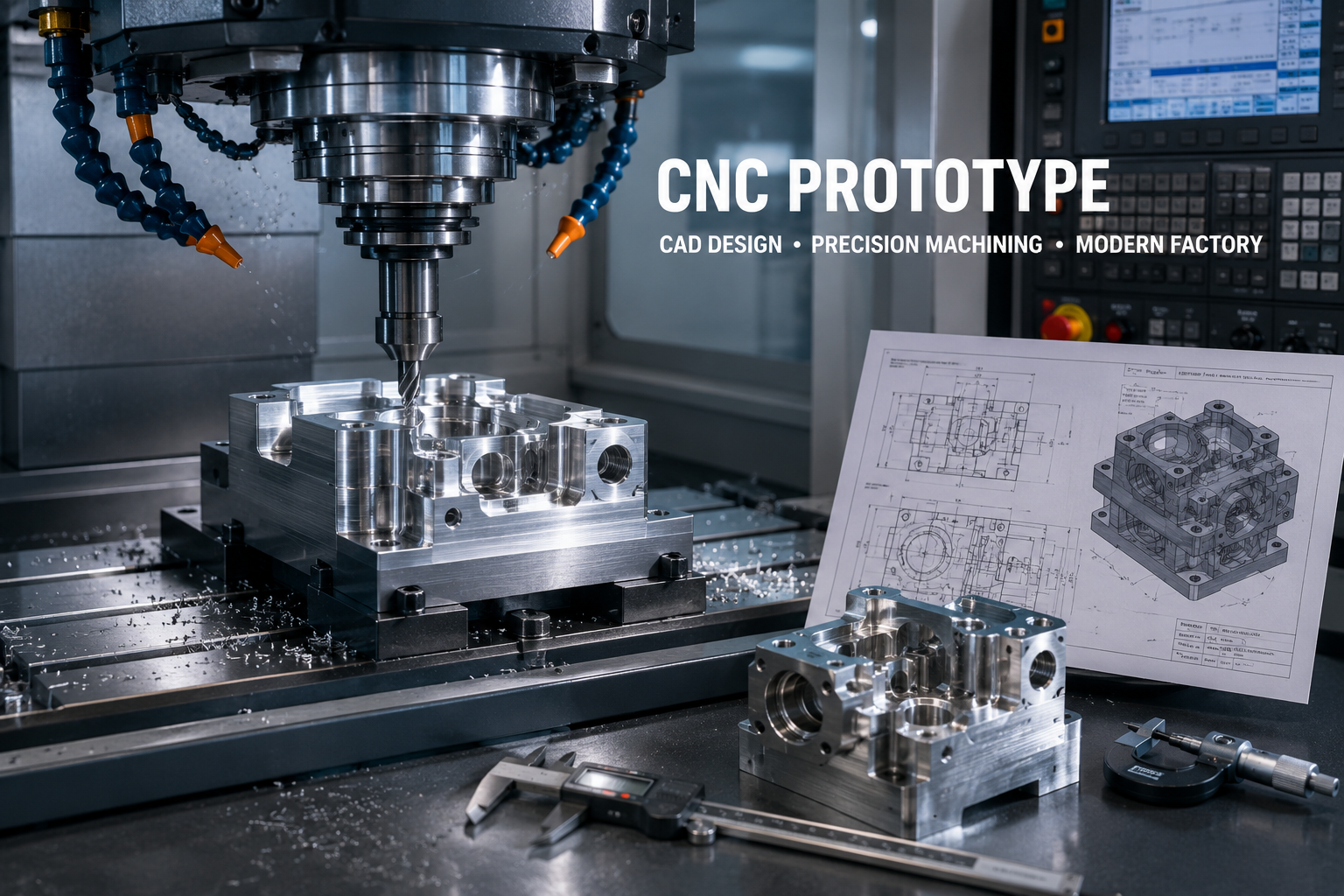
Developing a new product often requires multiple rounds of testing and improvement before moving into mass production. CNC prototype machining provides a fast and reliable way to turn CAD designs into functional physical parts for testing, validation, and product development.
Unlike mass production methods such as injection molding, CNC machining does not require expensive production molds. This makes it particularly suitable for prototypes, one-off parts, and low-volume production.
In this guide, we’ll explain what CNC prototype machining is, how the process works, its advantages, costs, applications, and how to design better prototypes for CNC manufacturing.
What Is CNC Prototype Machining?
CNC prototype machining is the process of using computer-controlled machine tools to manufacture physical prototypes directly from a digital CAD design.
A CNC machine removes material from a solid block or piece of stock until the desired shape is produced.
Common CNC prototype materials include:
- Aluminum
- Stainless steel
- Brass
- Titanium
- ABS
- POM
- Nylon
- Acrylic
Because CNC machining can produce parts from the same or similar materials used in final products, engineers can test prototypes under realistic conditions.
How Does CNC Prototype Machining Work?
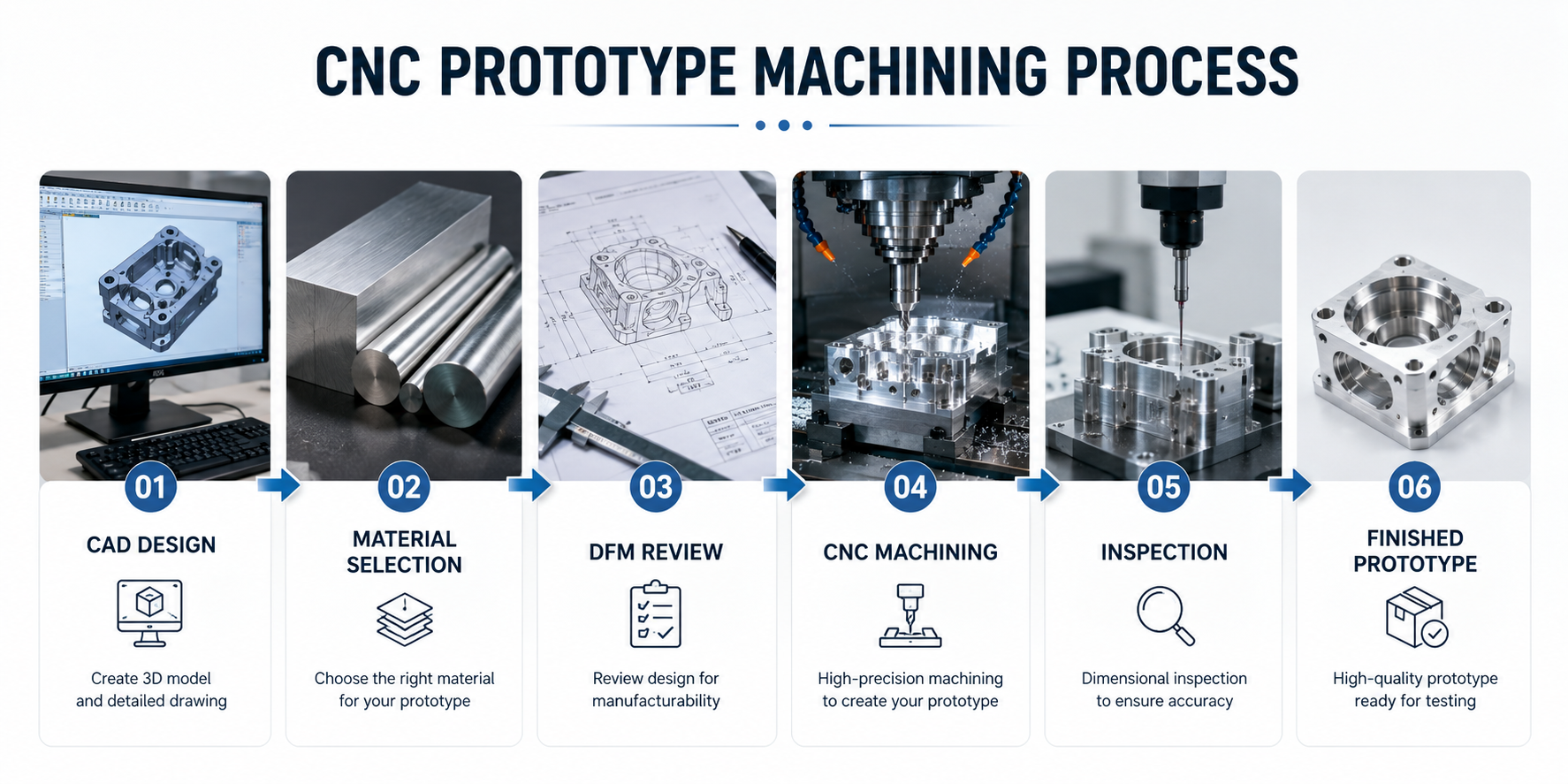
The CNC prototyping process typically involves several steps.
1. Create a CAD Design
The process starts with a 3D CAD model or technical drawing.
Common file formats include:
- STEP
- STP
- IGES
- STL
- DWG
- DXF
The CAD model defines the geometry and dimensions of the prototype.
2. Choose the Material
The appropriate material depends on the prototype’s intended application.
For example:
Aluminum is suitable when lightweight and machinability are important.
Stainless steel is a good choice when strength and corrosion resistance are required.
POM or Nylon can be used for lightweight mechanical components.
Choosing the correct material early can make prototype testing more meaningful.
3. Review the Design for Manufacturability
Before machining begins, engineers review the CAD design to identify potential manufacturing problems.
The review may consider:
- Wall thickness
- Internal radii
- Hole sizes
- Tolerances
- Tool accessibility
- Material selection
- Surface finish
A DFM review can help prevent unnecessary redesigns and reduce manufacturing costs.
4. CNC Programming
Once the design is approved, CAM software is used to generate CNC toolpaths.
The machining strategy determines:
- Cutting tools
- Cutting speeds
- Feed rates
- Machining operations
- Toolpaths
More complex parts may require multi-axis machining or multiple setups.
5. CNC Machining
The selected material is secured in the CNC machine.
The machine then follows the programmed toolpaths to remove material and create the prototype.
Depending on the design, the part may require:
- CNC milling
- CNC turning
- Drilling
- Boring
- Threading
- Multi-axis machining
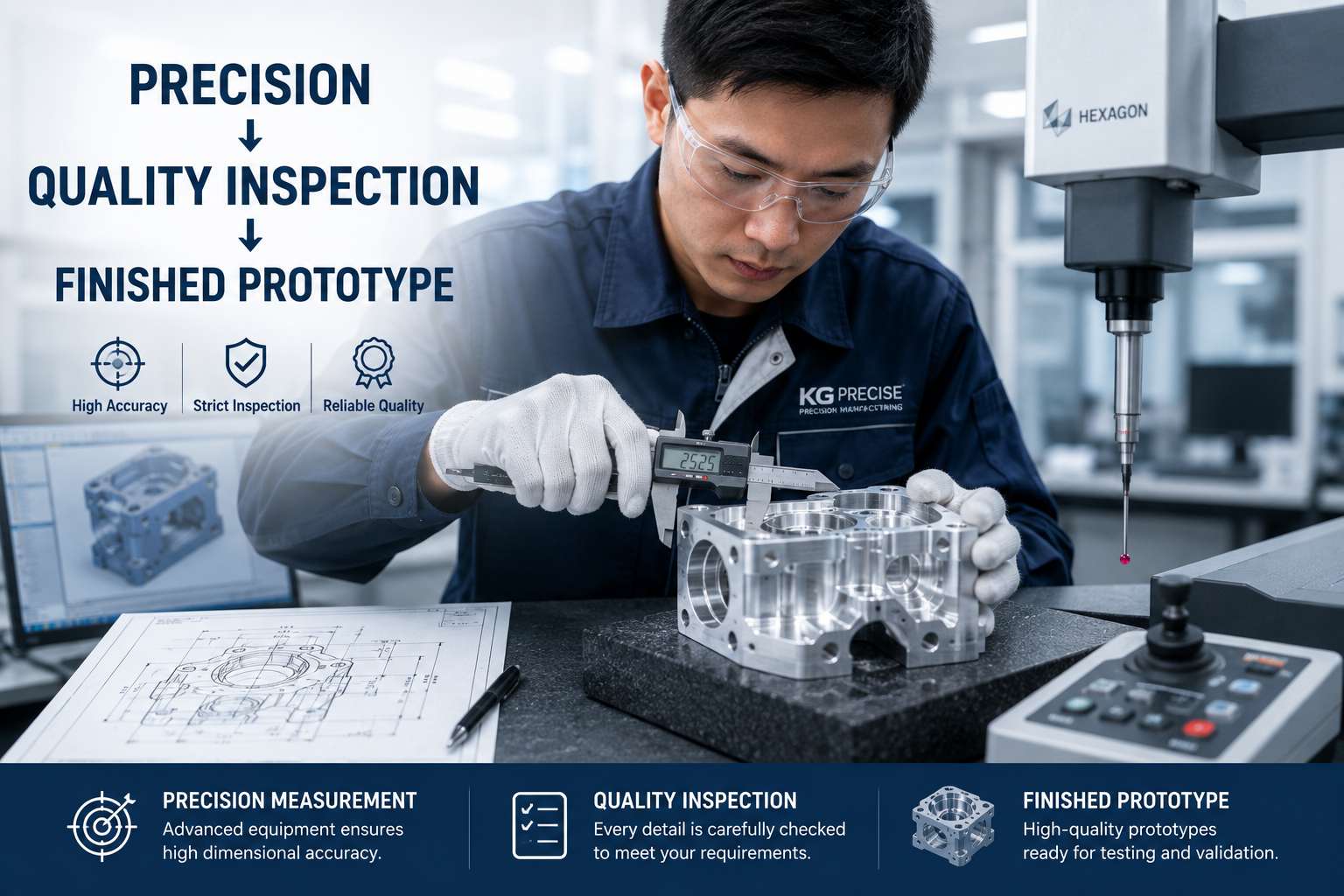
6. Inspection and Finishing
After machining, the prototype is inspected to verify that it meets the required dimensions.
Additional finishing processes may include:
- Anodizing
- Bead blasting
- Polishing
- Brushing
- Powder coating
The final prototype can then be tested and evaluated.
Benefits of CNC Prototype Machining
1. Fast Prototyping
CNC machining can produce functional prototypes without requiring production molds.
This allows engineers to move quickly from:
CAD Design → Prototype → Testing → Design Improvements
Fast iteration can shorten product development cycles.
2. Functional Prototypes
One major advantage of CNC prototypes is that they can be manufactured from real engineering materials.
This allows engineers to evaluate:
- Strength
- Fit
- Function
- Heat resistance
- Wear resistance
- Dimensional accuracy
A prototype made from the intended production material can provide more useful testing results than a simple visual model.
3. High Accuracy
CNC machining can produce highly accurate components with tight dimensional control.
This makes CNC prototyping suitable for applications where:
- Parts need to fit together
- Moving components need precise clearances
- Functional testing is required
However, unnecessarily tight tolerances can increase manufacturing costs.
4. No Mold Required
Injection molding requires a production mold, which can involve significant upfront costs.
CNC machining removes material directly from stock, so no injection mold is required.
This makes CNC machining particularly attractive for:
- One-off prototypes
- Small quantities
- Early-stage product development
5. Wide Material Selection
CNC machines can process a broad range of materials.
Engineers can choose materials based on:
- Strength
- Weight
- Corrosion resistance
- Temperature resistance
- Appearance
- Cost
This flexibility makes CNC machining suitable for many industries.
CNC Prototyping vs. 3D Printing
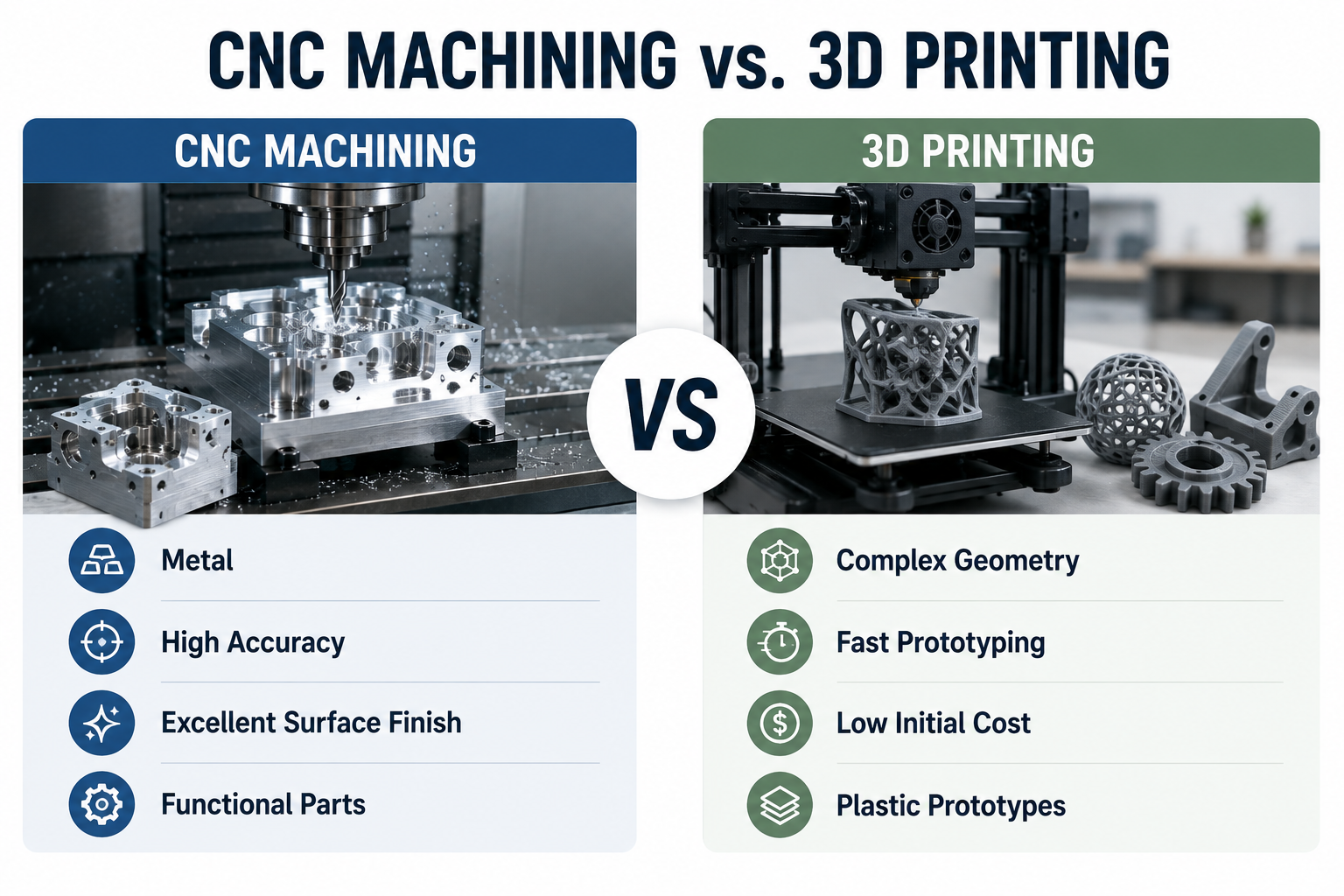
CNC machining and 3D printing are both widely used for rapid prototyping, but they have different strengths.
| Feature | CNC Machining | 3D Printing |
|---|---|---|
| Material | Metals and plastics | Mainly polymers, some metals |
| Accuracy | High | Moderate to high |
| Surface Finish | Excellent | Depends on technology |
| Strength | Excellent | Depends on material/process |
| Complex Geometry | Good | Excellent |
| Material Properties | Production-like | Technology dependent |
| Tooling Required | No mold | No mold |
| Best For | Functional prototypes | Complex prototypes |
Choose CNC machining when:
- You need metal prototypes
- High dimensional accuracy is important
- Surface finish matters
- The prototype needs to withstand mechanical loads
Choose 3D printing when:
- Geometry is highly complex
- Speed is the priority
- You need inexpensive visual prototypes
- Internal structures are difficult to machine
In some product development workflows, CNC machining and 3D printing can complement each other.
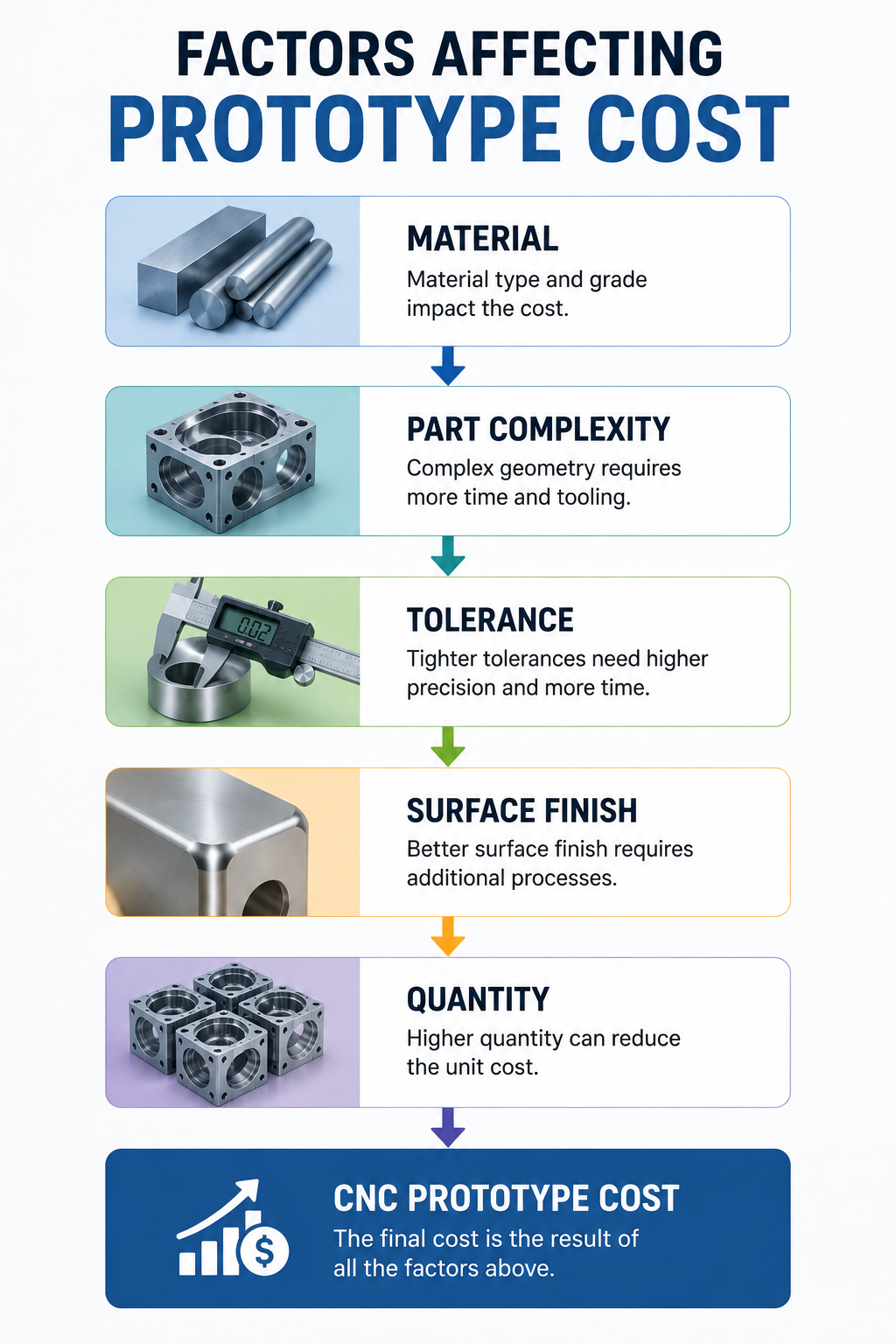
What Affects CNC Prototype Machining Cost?
CNC prototype costs vary depending on several factors.
Material
Different materials have different raw material costs and machining characteristics.
For example, aluminum is generally easier to machine than titanium.
Part Complexity
Complex geometries require more programming, tooling, and machining time.
Features such as:
- Deep pockets
- Thin walls
- Complex curves
- Small holes
- Tight internal corners
can increase the cost.
Tolerances
Tighter tolerances usually require additional machining and inspection.
Only specify precision tolerances where they are necessary for the function of the prototype.
Surface Finish
Additional finishing processes increase the total cost.
A simple as-machined surface is usually less expensive than polishing, anodizing, or other secondary treatments.
Quantity
Although CNC machining is suitable for one-off prototypes, producing several prototypes at once can reduce the average cost per part.
Setup and programming costs can be distributed across multiple parts.
How to Reduce CNC Prototype Costs
You can reduce prototype costs by optimizing the design before machining.
1. Use Standard Materials
Commonly available materials are usually easier and faster to source.
2. Avoid Unnecessary Tight Tolerances
Apply precision tolerances only to critical dimensions.
3. Simplify the Geometry
Avoid unnecessary complex features that don’t contribute to the function of the prototype.
4. Minimize Machining Setups
Designing parts that can be machined from fewer orientations can reduce setup time.
5. Choose Appropriate Surface Finishes
Don’t apply expensive finishing processes unless they are necessary for testing or appearance.
Applications of CNC Prototype Machining
CNC prototyping is widely used across many industries.
Automotive
Used for:
- Engine components
- Brackets
- Housings
- Interior components
- Functional prototypes
Aerospace
CNC prototypes are useful for testing lightweight and high-strength components.
Robotics
Applications include:
- Robot arms
- Mounting brackets
- Motor housings
- Structural components
Consumer Electronics
CNC machining can produce:
- Product housings
- Heat sinks
- Structural components
- Functional prototypes
Medical Devices
CNC prototypes can help engineers test the fit, function, and performance of medical equipment components.
When Should You Choose CNC Prototype Machining?
CNC prototype machining is a strong option when you need a physical prototype that is:
- Accurate
- Functional
- Durable
- Made from engineering materials
- Suitable for real-world testing
It is particularly useful during the early stages of product development, before committing to expensive production tooling.
CNC Prototype Machining at KG Precise
At KG Precise, we provide CNC prototype machining and low-volume manufacturing services for custom metal and plastic parts.
Our capabilities include:
- CNC milling
- CNC turning
- Multi-axis machining
- Surface finishing
- Dimensional inspection
Our engineering team can review your CAD files and help you select suitable materials, tolerances, machining methods, and finishing options.
Whether you need a single prototype or a small production run, we can help turn your design into a functional part.
Upload your CAD file to request a quote.
Conclusion
CNC prototype machining provides an efficient way to turn digital designs into accurate, functional physical parts.
With no production mold required, CNC machining is particularly suitable for one-off prototypes, product testing, and low-volume manufacturing.
By selecting the right material, optimizing the design, and applying realistic tolerances, engineers can reduce prototype costs while achieving the performance needed for testing.
If you need a reliable CNC prototype machining partner, KG Precise can help you move from CAD design to finished parts efficiently.