(+035) 527-1710-70
 NEWSLETTER


When requesting CNC machined parts, one of the most important specifications you’ll encounter is tolerance. Tolerances determine how much variation is acceptable in a part’s dimensions. Choosing the right tolerance can significantly affect manufacturing cost, production time, and product performance.
In this guide, we’ll explain what CNC machining tolerances are, the difference between standard and precision tolerances, and how to choose the right tolerance for your project.
What Are CNC Machining Tolerances?
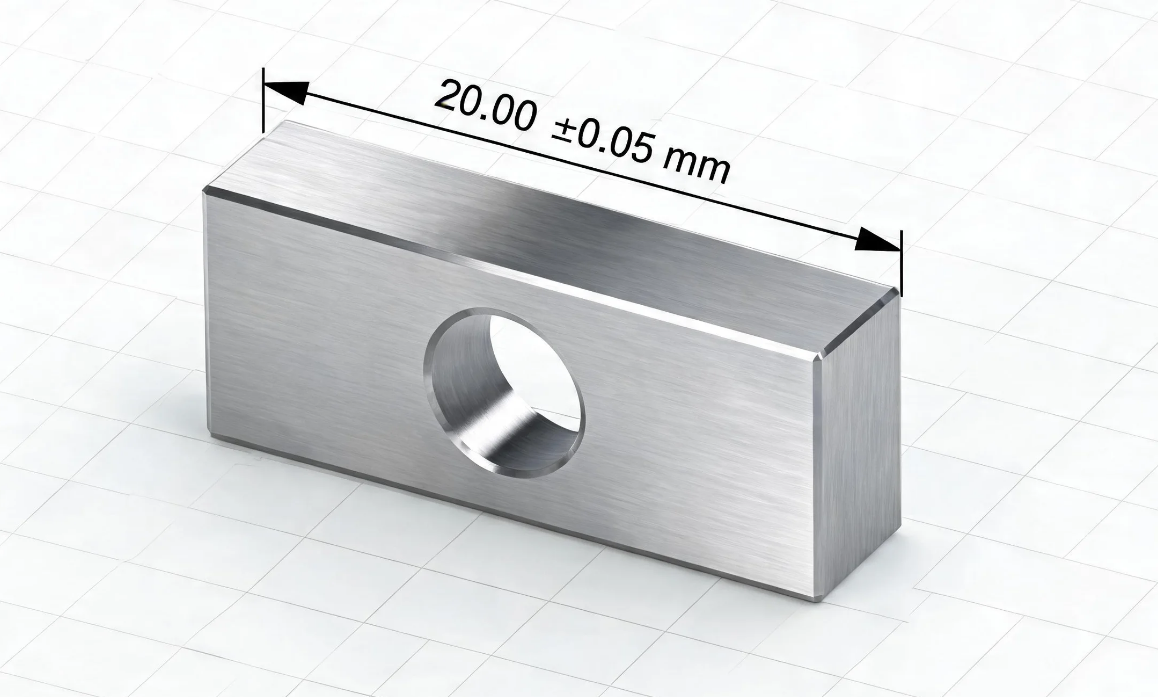
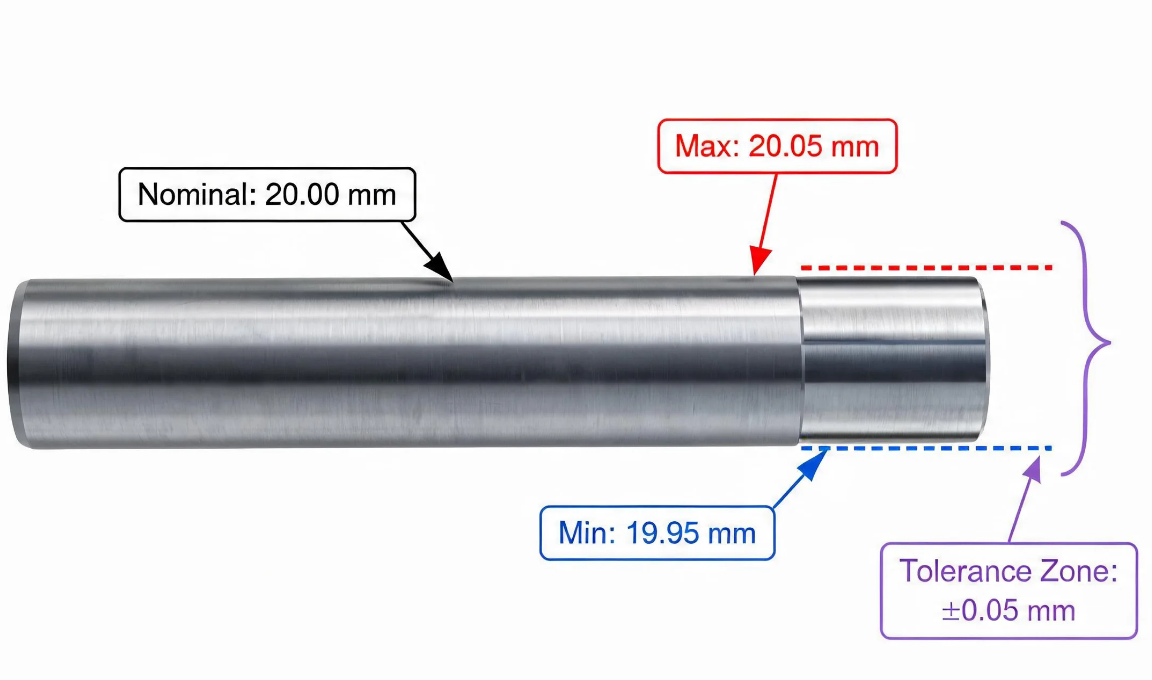
A machining tolerance defines the allowable deviation from a specified dimension.
For example, if a hole diameter is specified as 20.00 mm ±0.05 mm, any finished hole between 19.95 mm and 20.05 mm meets the design requirement.
No manufacturing process can produce perfectly identical parts every time. Tolerances ensure that parts remain functional while accounting for normal manufacturing variations.
Why Are Tolerances Important?
Proper tolerances help ensure that:
- Components fit together correctly
- Mechanical assemblies operate smoothly
- Products meet quality requirements
- Manufacturing costs remain under control
Specifying unnecessarily tight tolerances increases machining time, inspection requirements, and production costs.
Standard vs. Precision Tolerances
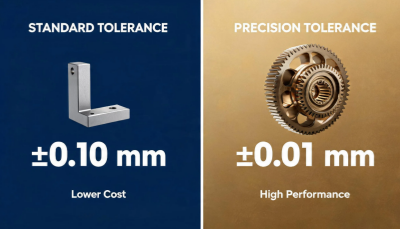
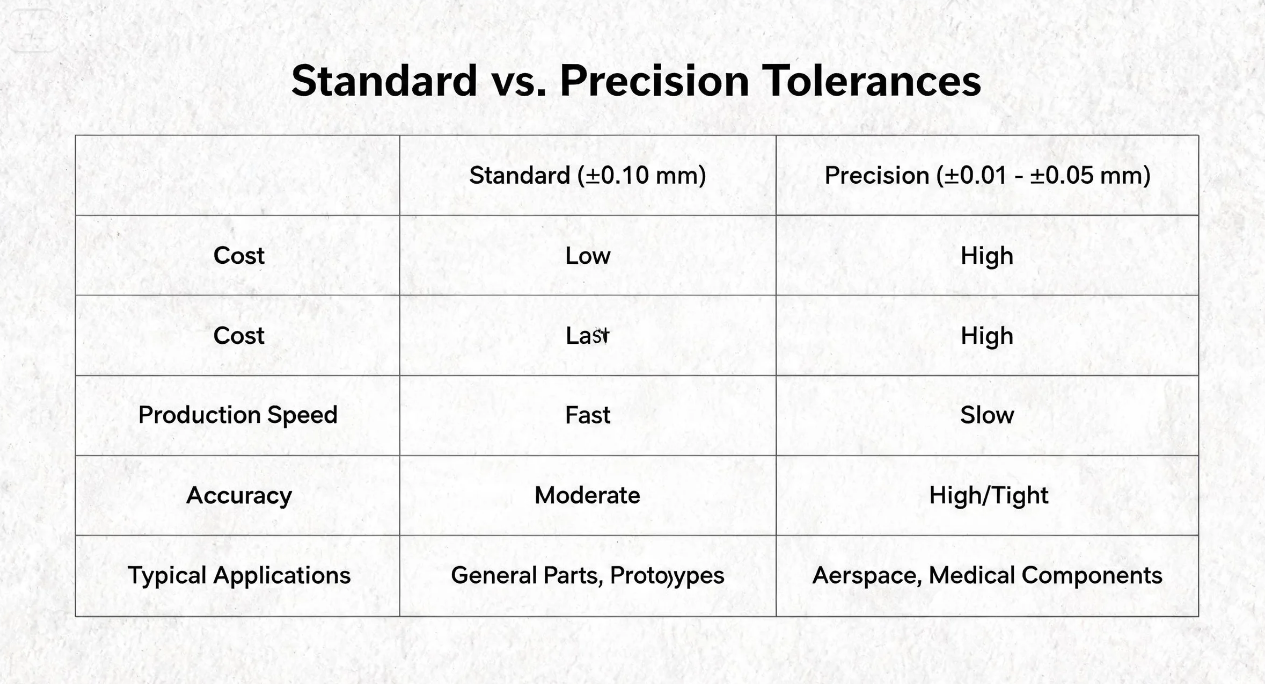
Standard Tolerances
Standard tolerances are suitable for most general-purpose machined parts.
Typical standard tolerance:
±0.10 mm (±0.004 in)
Advantages include:
- Lower manufacturing cost
- Faster production
- Easier machining
- Ideal for non-critical dimensions
Applications include:
- Brackets
- Covers
- Housings
- Fixtures
- Consumer product components
Precision Tolerances
Precision tolerances are required when parts must fit or function with minimal clearance.
Typical precision tolerance:
±0.01 mm to ±0.05 mm
Advantages include:
- Excellent dimensional accuracy
- Better assembly consistency
- Improved product performance
Applications include:
- Medical devices
- Aerospace components
- Automotive precision parts
- Optical equipment
- High-performance mechanical assemblies
How Tight Tolerances Affect Manufacturing Cost
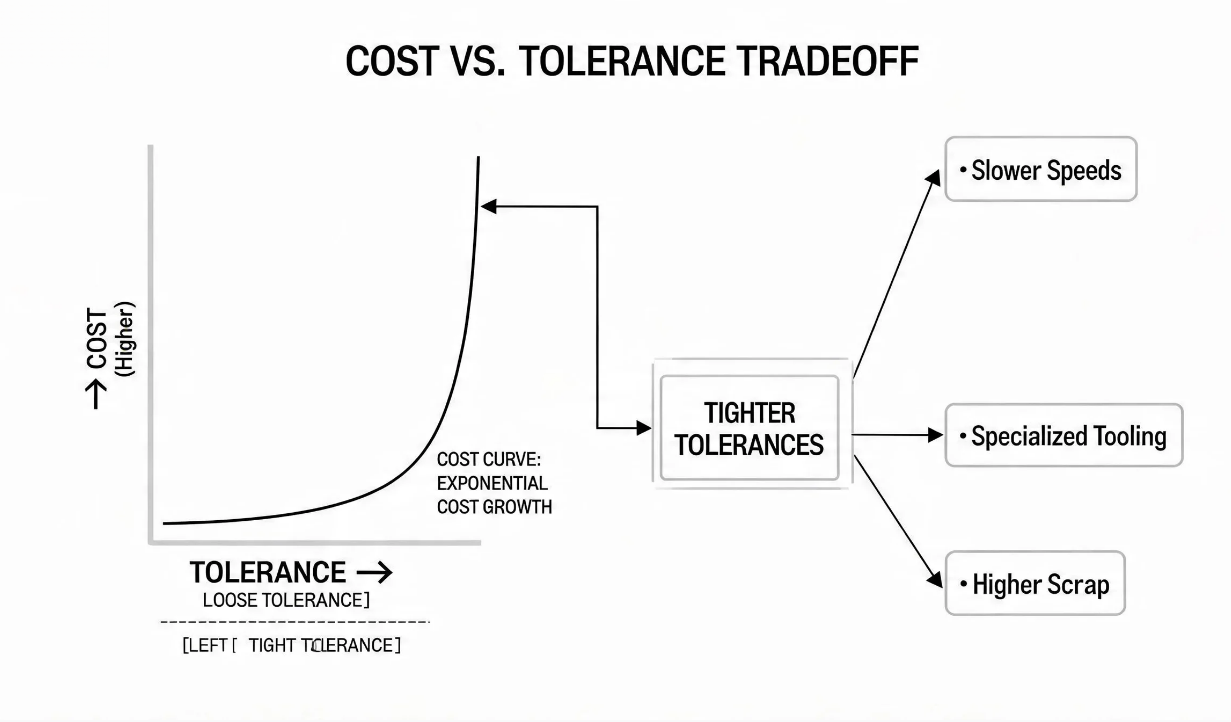
Many engineers assume tighter tolerances always result in better products. However, this isn’t always true.
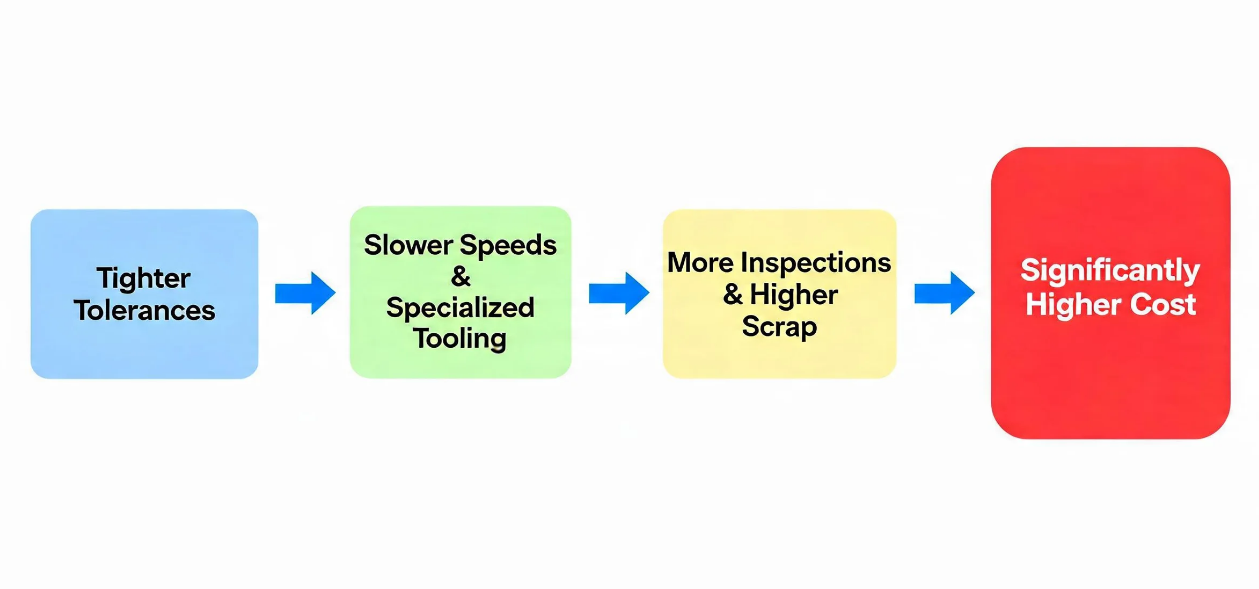
Tighter tolerances usually require:
- Additional machining operations
- Slower cutting speeds
- Specialized tooling
- More frequent inspections
- Higher scrap rates
As tolerances become tighter, manufacturing costs can increase significantly.
Whenever possible, use the loosest tolerance that still meets your functional requirements.
Factors That Influence Achievable Tolerances
Several factors affect machining accuracy:
Material
Different materials respond differently during machining.
For example:
- Aluminum offers excellent dimensional stability.
- Stainless steel is harder to machine.
- Plastics may expand or contract due to temperature.
Machine Capability
Modern CNC machining centers deliver higher precision than older equipment.
Machine rigidity, spindle accuracy, and thermal stability all influence achievable tolerances.
Part Geometry
Complex features are often more difficult to machine accurately.
Examples include:
- Deep pockets
- Thin walls
- Long shafts
- Small internal radii
These features may require additional setups or specialized tooling.
Surface Finish Requirements
A smoother surface finish often requires additional finishing operations, which can also affect dimensional accuracy.
Balancing surface finish and tolerance is essential for cost-effective production.
General CNC Machining Tolerance Guidelines
| Feature | Typical Standard Tolerance |
|---|---|
| Linear dimensions | ±0.10 mm |
| Hole diameter | ±0.05–0.10 mm |
| Shaft diameter | ±0.02–0.05 mm |
| Threaded holes | According to thread standards |
| Flatness | Depends on part size |
| Perpendicularity | Depends on tolerance requirements |
Actual achievable tolerances depend on material, geometry, and manufacturing process.
Tips for Designing Cost-Effective CNC Parts
To reduce machining costs while maintaining quality:
- Avoid unnecessarily tight tolerances.
- Apply precision tolerances only to critical features.
- Use standard drill sizes whenever possible.
- Design thicker walls instead of extremely thin sections.
- Consult your manufacturing partner early during the design stage.
These practices improve manufacturability and shorten production lead times.
How We Help Achieve High-Quality CNC Parts
At KG Rapid Prototype, we manufacture precision CNC machined components for industries including automotive, robotics, electronics, industrial equipment, and consumer products.
Our experienced engineering team reviews every drawing before production to ensure manufacturability, optimize tolerances, and deliver cost-effective solutions without compromising quality.
Whether you need prototype parts or low-volume production, we can help you achieve the right balance between precision, performance, and budget.
Conclusion
Understanding CNC machining tolerances is essential for designing reliable, cost-effective parts. While tighter tolerances may improve precision, they also increase manufacturing complexity and cost.
By specifying tolerances based on actual functional requirements, manufacturers can reduce production costs while maintaining excellent product performance.
If you’re unsure which tolerance is appropriate for your design, our engineering team is ready to provide expert guidance and help optimize your project before production.